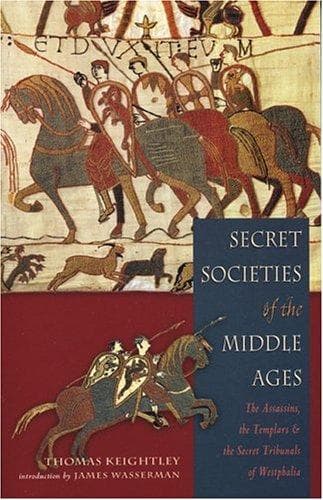
Secret Societies of the Middle AgesKeightley, Thomas
History
Secret Societies of the Middle Ages
Keightley, Thomas
Secret societies
The slaughter of the Ismaïlites by the Prince of Damascus was not
forgotten, and two years afterwards he received two dagger wounds, one
of which proved mortal. Their vengeance was not appeased by his blood,
and his son and successor, Shems-al-Molook (_Sun of Kings_), perished by
a conspiracy with the guilt of which the Assassins were charged. In the
catalogue of the victims of this period appear also the names of the
Judges of the East and of the West, of the Mufti of Casveen, of the Reis
of Isfahan, and the Reis of Tebreez.
The East has been at all times prolific of crime; human life is not
there held to be of the value at which it is estimated in Europe; and
the dagger and poison are freely employed to remove objects of
apprehension, to put obstacles out of the way of ambition, or to satiate
the thirst of vengeance. We are not, therefore, lightly to give credit
to every charge made against the Assassins, and to believe them guilty
of murders from which they had no advantage to derive. Thus, when at
this time the Fatimite Khalif Amir bi-ahkami-llah (_Commander of the
observance of the laws of God_) fell by the hands of murderers, the
probability is that he was not a victim to the vengeance of the
Ismaïlite society, whom he had never injured, but rather to that of the
family of the powerful vizir Afdal, who had been assassinated some time
before by the khalif's order, as we have every reason to suppose.
With a greater show of reason may the murder of Mostarshed, the Khalif
of Bagdad, be imputed to the policy of the mountain chief. The
Seljookian princes, the predecessors of Massood, had been satisfied to
exercise all real power in the empire which had once obeyed the house of
Abbas, leaving to that feeble _Shadow of God upon Earth_ the
unsubstantial privilege of having the coin of the realm struck and
prayers offered on Friday in the mosk in his name. But Massood arrogated
even these rights to himself, and the helpless successor of the Prophet
was obliged to submit to the indignity which he could not prevent. At
length some discontented military chiefs passed with their troops over
to the khalif, and persuaded him that by one bold effort he might
overthrow the might of the Turkish sultan, and recover all his rights.
The khalif listened to their arguments, and, placing himself at the head
of an army, marched against Sultan Massood. But fortune proved adverse
to him. At the first shock the greater part of the troops of Bagdad
abandoned him, and he remained a captive in the hands of the sultan, who
brought him with him a prisoner to Maragha. Here a treaty was concluded
between them, and the khalif bound himself not to go any more outside of
the walls of Bagdad, and annually to pay a sum of money. This treaty
appears to have been displeasing to the Assassins; and, watching their
opportunity, when Massood was gone to meet the ambassadors of Sultan
Sanjar, a party of them fell upon and massacred the khalif and his
train.
Public-domain text, read in full here on John Shaqi.
Reviews
Reviews
No reviews yet
Be the first to share your thoughts on this work.
Elsewhere in the archive
Join the Discussion
Join the discussion
Sign in to leave a comment or review.
Sign InorCreate an account