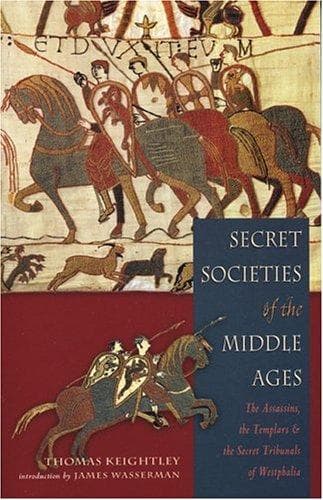
Secret Societies of the Middle AgesKeightley, Thomas
History
Secret Societies of the Middle Ages
Keightley, Thomas
Secret societies
It was necessary, therefore, that he should prove himself to be of the
blood of the Fatimites. He accordingly began to drop some dark hints
respecting the truth of the received opinion of his being the son of
Keäh Mohammed. Our readers will recollect that, when Hassan Sabah was in
Egypt, a dispute had taken place respecting the succession to the
throne, in which Hassan had nearly lost his life for opposing the
powerful commander-in-chief (_Emir-al-Jooyoosh_), and Nezar, the prince
for whom the khalif Mostanser had designed the succession, had been
deprived of his right by the influence of that officer. The confidents
of Hassan now began to give out that, in about a year after the death of
the khalif Mostanser, a certain person named Aboo-'l-Zeide, who had been
high in his confidence, had come to Alamoot, bearing with him a son of
Nezar, whom he committed to the care of Hassan Sabah, who, grateful to
the memory of the khalif and his son, had received the fugitive with
great honour, and assigned a village at the foot of Alamoot for the
residence of the young imam. When the youth was grown up he married and
had a son, whom he named _On his Memory be Peace_. Just at the time when
the imam's wife was confined in the village, the consort of Keäh
Mohammed lay in at the castle; and, in order that the descendant of
Fatima might come to the temporal power which was his right, a
confidential woman undertook and succeeded in the task of secretly
changing the children. Others went still further, and did not hesitate
to assert that the young imam had intrigued with the wife of Keäh
Mohammed, and that Hassan was the fruit of their adulterous intercourse.
Like a true pupil of ambition, Hassan was willing to defame the memory
of his mother, and acknowledge himself to be a bastard, provided he
could succeed in persuading the people to believe him a descendant of
the Prophet.
These pretensions of Hassan to a Fatimite pedigree gave rise to a
further increase of the endless sects into which the votaries of Islam
were divided. Those who acknowledged it got the name of Nezori, and by
them Hassan was called the Lord of the Resurrection (_Kaim-al-Kiamet_),
and they styled themselves the Sect of the Resurrection.
The reign of the vain, inconsiderate Hassan was but short. He had
governed the society only four years when he was assassinated by his
brother-in-law, Namver, a descendant, we are told, of the family of
Buyah, which had governed the khalifs and their dominions before the
power passed into the hands of the Turkish house of Seljook.
CHAPTER VIII.
Mohammed II.--Anecdote of the Imam
Fakhr-ed-deen--Noor-ed-deen--Conquest of Egypt--Attempt on the Life
of Saladin.
Public-domain text, read in full here on John Shaqi.
Reviews
Reviews
No reviews yet
Be the first to share your thoughts on this work.
Elsewhere in the archive
Join the Discussion
Join the discussion
Sign in to leave a comment or review.
Sign InorCreate an account