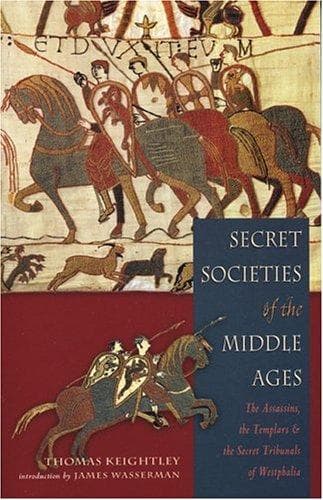
Secret Societies of the Middle AgesKeightley, Thomas
History
Secret Societies of the Middle Ages
Keightley, Thomas
Secret societies
The death of Hassan was amply avenged by his son and successor, Mohammed
II. Not only was the murderer himself put to death; vengeance, in its
oriental form, extended itself to all his kindred of both sexes, and
men, women, and children bled beneath the sword of the executioner.
Mohammed, who had been carefully trained up in the study of philosophy
and literature, was, like his father, puffed up with vanity and
ambition, and, far from receding from any of his predecessor's
pretensions to the imamat, he carried them to even a still greater
length than he had done. At the same time he maintained a high character
for knowledge and talent among his literary contemporaries, who were
numerous, for his reign extended through a period of forty-six years,
and the modern Persian literature was now fast approaching its climax.
Not to mention other names, less familiar to our readers, we shall
remark, as a proof of what we have said, that this was the period in
which Nizamee of Ghenj sang in harmonious numbers the loves of Khosroo
and Shireen, and of Mujnoon and Leila (these last the Romeo and Juliet
of the east), the crown and flower of the romantic poetry of Persia.
Then too flourished the great panegyrist Enveree, and a crowd of
historians, jurists, and divines.
One of the most celebrated men of this time was the imam Fakhr-ed-deen
(_Glory of Religion_) Rasi, who gave public lectures on the law in his
native city of Rei. It being slanderously reported that he was devoted
in secret to the opinions of the Ismaïlites, and was even one of their
missionaries, he adopted the ordinary expedient of abusing and reviling
that sect, and each time he ascended the pulpit to preach he reprobated
and cursed the _Impious_ in no measured terms. Intelligence of what he
was about was not long in reaching the eyrie of the Sheikh-al-Jebal, and
a Fedavee received his instructions, and forthwith set out for Rei. He
here entered himself as a student of the law, and sedulously attended
the lectures of the learned imam. During seven months he watched in vain
for an opportunity of executing his commission. At length he discovered
one day that the attendants of the imam had left him to go to fetch him
some food, and that he was alone in his study. The Fedavee entered,
fastened the doors, seized the imam, cast him on the ground, and
directed his dagger at his bosom. "What is thy design?" said the
astonished imam. "To rip up thy belly and breast." "And wherefore?"
"Wherefore? Because thou hast spoken evil of the Ismaïlites in the
pulpit." The imam implored and entreated, vowing that, if his life was
spared, he would never more say aught to offend the sect of Ismaïl. "I
cannot trust thee," cried the Assassin; "for when I am gone thou wilt
return to thy old courses, and, by some ingenious shift or other,
contrive to free thyself from the obligation of thy oath." The imam
then, with a most solemn oath, abjured the idea of explaining away his
words, or seeking absolution for perjury.
Public-domain text, read in full here on John Shaqi.
Reviews
Reviews
No reviews yet
Be the first to share your thoughts on this work.
Elsewhere in the archive
Join the Discussion
Join the discussion
Sign in to leave a comment or review.
Sign InorCreate an account