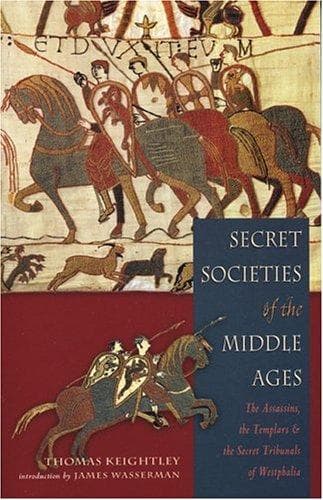
Secret Societies of the Middle AgesKeightley, Thomas
History
Secret Societies of the Middle Ages
Keightley, Thomas
Secret societies
The Assassin got up from over
him, saying, "I had no order to slay thee, or I should have put thee to
death without fail. Mohammed, the son of Hassan, greets thee, and
invites thee to honour him by a visit at his castle. Thou shalt there
have unlimited power, and we will all obey thee like trusty servants. We
despise, so saith the sheikh, the discourses of the rabble, which
rebound from our ears like nuts from a ball; but _you_ should not revile
us, since your words impress themselves like the strokes of the graver
in the stone." The imam replied that it was totally out of his power to
go to Alamoot, but that in future he should be most careful never to
suffer a word to pass his lips to the discredit of the mountain prince.
Hereupon the Fedavee drew 300 pieces of gold from his girdle, and,
laying them down, said, "See! here is thy annual pension; and, by a
decree of the divan, thou shalt every year receive an equal sum through
the reis Mozaffer. I also leave thee, for thy attendants, two garments
from Yemen, which the Sheikh-al-Jebal has sent thee." So saying, the
Fedavee disappeared. The imam took the money and the clothes, and for
some years his pension was paid regularly. A change in his language now
became perceptible, for, whereas he was used before, when, on treating
of any controverted point, he had occasion to mention the Ismaïlites, to
express himself thus, "Whatever the Ismaïlites, whom God curse and
destroy! may say,"--now that he was pensioned he contented himself with
merely saying, "Notwithstanding what the Ismaïlites may say." When one
of his scholars asked him the cause of this change he made answer, "We
cannot curse the Ismaïlites, they employ such _sharp_ and _convincing_
arguments." This anecdote is related by several of the Persian
historians, and it serves to prove, like the case of sultan Sanjar,
related above, that the Ismaïlites were not so thoroughly ruthless and
bloodthirsty as not to prefer rendering an enemy innocuous by gentle
means to depriving him of life.
Historians record no other event connected with the eastern
establishment of the Ismaïlite society during the long-reign of Mohammed
II. We shall now, therefore, turn our view to the Syrian branch, which
attracts attention by the illustrious names which appear in oriental
history at that time, and with which the ruler of Massyat came into
hostile or friendly relations. The names of Noor-ed-deen (_Light of
Religion_), Salah-ed-deen (_Integrity of Religion_), the Noradin and
Saladin of western writers, and the Lion-hearted king of England, will
at once awake the attention of the reader.
Public-domain text, read in full here on John Shaqi.
Reviews
Reviews
No reviews yet
Be the first to share your thoughts on this work.
Elsewhere in the archive
Join the Discussion
Join the discussion
Sign in to leave a comment or review.
Sign InorCreate an account