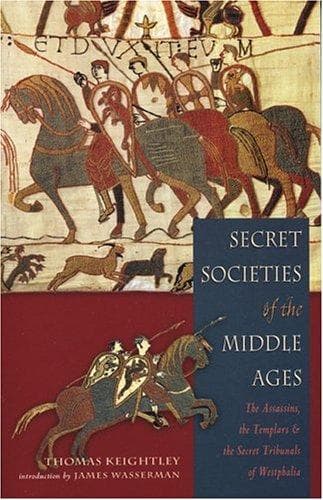
Secret Societies of the Middle AgesKeightley, Thomas
History
Secret Societies of the Middle Ages
Keightley, Thomas
Secret societies
"In the province of Phoenicia, near the borders of the Antaradensian
town which is now called Tortosa, dwells a certain people, shut in on
all sides by rocks and mountains, who have ten castles, very strong and
impregnable, by reason of the narrow ways and inaccessible rocks, with
their suburbs and the valleys, which are most fruitful in all species of
fruits and corn, and most delightful for their amenity. The number of
these men, who are called Assassins, is said to exceed 40,000[51]. They
set a captain over themselves, not by hereditary succession, but by the
prerogative of merit, whom they call the Old Man (_Veterem seu Senem_),
not so much on account of his advanced age as for his pre-eminence in
prudence and dignity. The first and principal _abbot_ of this unhappy
_religion_ of theirs, and the place where they had their origin and
whence they came to Syria, is in the very remote parts of the east, near
the city of Bagdad and the parts of the province of Persia. These
people, who do not divide the hoof, nor make a difference between what
is sacred and what is profane, believe that all obedience indifferently
shown by them towards their superior is meritorious for eternal life.
Hence they are bound to their master, whom they call the Old Man, with
such a bond of subjection and obedience that there is nothing so
difficult or so dangerous that they would fear to undertake, or which
they would not perform with a cheerful mind and ardent will, at the
command of their lord. The Old Man, their lord, causes boys of this
people to be brought up in secret and delightful places, and having had
them diligently trained and instructed in the different kinds of
languages, sends them to various provinces with daggers, and orders them
to slay the great men of the Christians, as well as of the Saracens,
either because he is at enmity with them for some cause or other, or at
the request of his friends, or even for the lucre of a large sum of
money which has been given him, promising them, for the execution of
this command, that they shall have far greater delights, and without
end, in paradise, after death, than even those amidst which they had
been reared. If they chance to die in this act of obedience they are
regarded as martyrs by their companions, and being placed by that people
among their saints, are held in the greatest reverence. Their parents
are enriched with many gifts by the master, who is called the Old Man,
and if they were slaves they are let go free ever after. Whence these
wretched and misguided youths, who are sent from the convent
(_conventu_) of the aforesaid brethren to different parts of the world,
undertake their deadly legation with such joy and delight, and perform
it with such diligence and solicitude, transforming themselves in
various ways, and assuming the manners and dress of other nations,
sometimes concealing themselves under the appearance of merchants, at
Public-domain text, read in full here on John Shaqi.
Reviews
Reviews
No reviews yet
Be the first to share your thoughts on this work.
Elsewhere in the archive
Join the Discussion
Join the discussion
Sign in to leave a comment or review.
Sign InorCreate an account