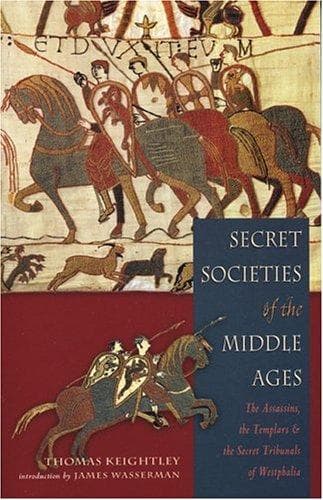
Secret Societies of the Middle AgesKeightley, Thomas
History
Secret Societies of the Middle Ages
Keightley, Thomas
Secret societies
other times under that of priests and monks, and in an infinity of other
modes, that there is hardly any person in the whole world so cautious as
to be able to guard against their machinations. They disdain to plot
against an inferior person. The great men to whom they are hostile
either redeem themselves by a large sum of money, or, going armed and
attended by a body of guards, pass their life in suspicion and in dread
of death. They kept the law of Mahomet and his institutions diligently
and straitly beyond all other Saracens till the times of a certain
master of theirs, who, being endowed with natural genius, and exercised
in the study of different writings, began with all diligence to read and
examine the law of the Christians and the Gospels of Christ, admiring
the virtue of the miracles, and the sanctity of the doctrine. From a
comparison with these he began to abominate the frivolous and irrational
doctrine of Mahomet, and at length, when he knew the truth, he studied
to recall his subjects by degrees from the rites of the cursed law.
Wherefore he exhorted and commanded them that they should drink wine in
moderation and eat the flesh of swine. At length, after many discourses
and serious admonitions of their teacher, they all with one consent
agreed to renounce the perfidy of Mahomet, and, by receiving the grace
of baptism, to become Christians."
[Footnote 51: William of Tyre makes their number 60,000. He declares his
inability to give the origin of the name Assassins.]
We may, from this account, perceive that the Crusaders had a tolerably
clear idea of the nature and constitution of the society of the
Assassins. The Cardinal de Vitry plainly describes them as forming a
_religion_, that is, an order under an abbot; and perhaps the
resemblance which Hammer traces between them and the Templars, which we
shall notice when we come to speak of this last society, is not quite so
fanciful as it might at first sight appear. It is curious, too, to
observe that the Christians also believed that the Sheikh-al-Jebal had
some mode of inspiring the Fedavee with a contempt of life and an
aspiration after the joys of paradise.
The dagger had not been unsheathed against the Christian princes since,
forty-two years before (1149), Raymond, the young Count of Tripolis, was
murdered as he knelt at his devotions, and the altar was sprinkled with
his blood. A more illustrious victim was now to bleed; and, as the
question of who was the real author of his death forms a curious
historical problem, we shall here discuss it at some length.
Public-domain text, read in full here on John Shaqi.
Reviews
Reviews
No reviews yet
Be the first to share your thoughts on this work.
Elsewhere in the archive
Join the Discussion
Join the discussion
Sign in to leave a comment or review.
Sign InorCreate an account