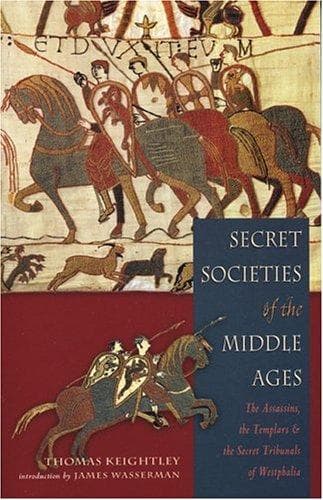
Secret Societies of the Middle AgesKeightley, Thomas
History
Secret Societies of the Middle Ages
Keightley, Thomas
Secret societies
We will not undertake to maintain the genuineness of these two epistles,
but we may be permitted to point out the futility of some of the
objections made to them. Hammer pronounces the first of them to be an
undoubted forgery because it commences with swearing by the law, and
ends by being dated from the era of the Seleucides. Both, he says, were
equally strange to the Ismaïlites, who precisely at this time had begun
to trample the law under foot, and had abandoned the Hejra, the only era
known in Mohammedan countries, for a new one commencing with the reign
of Hassan II. He further sees, in the circumstance of a letter from the
Old Man of the Mountain (_Sheikh-al-Jebal_) being dated from Massyat, a
proof of the ignorance of the Crusaders respecting the true head and
seat of the Ismaïlite power. These objections are regarded by Wilken as
conclusive. They will, however, lose much of their force if we bear in
mind that the letters are manifestly translations, and that the chief of
Massyat at that time was Sinan, who some years before had offered to
become a Christian, and who does not seem at all to have adopted the
innovations of Hassan the Illuminator. Sinan might easily have been
induced by the friends of the King of England, one of the most steady of
whom was Henry of Champagne[54], who succeeded Conrad of Montferrat in
the kingdom, to write those letters in his justification, and it is very
probable that the translations were made in Syria, where the Arabic
language was of course better understood than in Europe, and sent either
alone or with the originals. The translator might have rendered the
title which Sinan gave himself by _Senex de Monte_, which would be
better understood in the west, and he may also have given the
corresponding year of the era of the Seleucides (the one in use among
the Syrian Christians) for the year of the Hejra used by the Ismaïlite
chief, or indeed Sinan may have employed that era himself. In this case
there would remain little to object to the genuineness of the letter to
the Duke of Austria. Hammer regards the expression _our simplicity_
(_simplicitas nostra_) as being conclusive against the genuineness of
the second letter. We must confess that we can see no force in the
objection. Sinan might wish to represent himself as a very plain,
simple, innocent sort of person. It might further be doubted if a
European forger would venture to represent the prince of the
Assassins--the formidable Old Man of the Mountain--in such a respectable
light as he appears in these two epistles[55].
[Footnote 54: An instance of Henry's intimacy with the Assassins has
been given in p. 81.]
[Footnote 55: Sir J. Mackintosh (History of England, i. 187) seems to
regard the letters as genuine.]
Public-domain text, read in full here on John Shaqi.
Reviews
Reviews
No reviews yet
Be the first to share your thoughts on this work.
Elsewhere in the archive
Join the Discussion
Join the discussion
Sign in to leave a comment or review.
Sign InorCreate an account