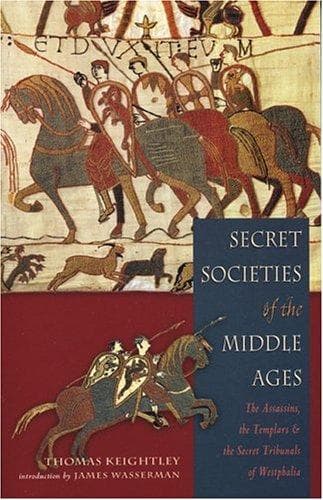
Secret Societies of the Middle AgesKeightley, Thomas
History
Secret Societies of the Middle Ages
Keightley, Thomas
Secret societies
But there is another account of the death of the Marquis of Montferrat,
which is probably much better known to the generality of readers than
any of the preceding ones. The far-famed author of "Waverley" has, in
his romantic tale of the "Talisman," made Conrad to be wounded and
vanquished in the lists by the son of the King of Scotland, the champion
of king Richard, and afterwards slain by the dagger, not of the
Assassins, but of his confederate in villany the Master of the Temple,
to prevent his making confession of their common guilt!
Yielding to none in rational admiration of the genius of Sir W. Scott,
we cannot avoid expressing a wish that he had ceased to write when he
had exhausted that rich field of national feelings and manners with
which he was alone familiar, and from which he drew the exquisite
delineations of "Waverley" and its Scottish brethren. All his later
works, no doubt, exhibit occasional scenes far beyond the power of any
of his imitators; but when his muse quits her native soil, she takes
leave of nature, truth, and simplicity. Even the genius of a Scott is
inadequate to painting manners he never witnessed, scenery he never
beheld.
The tale of the "Talisman" is a flagrant instance. Topography,
chronology, historic truth, oriental manners, and individual character,
are all treated with a most magnanimous neglect, indeed, even, we might
say, with contempt; for, careless, from "security to please," as the
author is known to have been, his vagaries must sometimes have proceeded
from mere wilfulness and caprice. It would, we apprehend, perplex our
oriental travellers and geographers to point out the site of the
fountain named the Diamond of the Desert, not far from the Dead Sea, and
yet lying half-way between the camp of the Saracens and that of the
Crusaders, which last, we are told, lay between Acre and Ascalon, that
is, on the sea-coast, or to show the interminable sandy desert which
stretches between the Dead Sea and the Mediterranean. As to historic
truth, we may boldly say that there is hardly a single circumstance of
the romance in strict accordance with history; and as to the truth of
individual character, what are we to say to the grave, serious,
religious Saladin, but the very year before his death, being in the
flower of his age, rambling alone through the desert, like an errant
knight, singing hymns to the Devil, and coming disguised as a physician
to the Christian camp, to cure the malady of the English monarch, whom
he never, in reality, did or would see[56]? We might enumerate many
additional instances of the violation of every kind of unity and
propriety in this single tale[57].
Public-domain text, read in full here on John Shaqi.
Reviews
Reviews
No reviews yet
Be the first to share your thoughts on this work.
Elsewhere in the archive
Join the Discussion
Join the discussion
Sign in to leave a comment or review.
Sign InorCreate an account