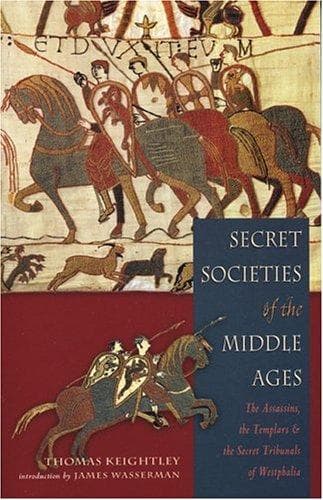
Secret Societies of the Middle AgesKeightley, Thomas
History
Secret Societies of the Middle Ages
Keightley, Thomas
Secret societies
[Footnote 56: May it not be said that real historic characters should
not be misrepresented? Sir W. Scott was at full liberty to make his
Varneys and his Bois Gilberts as accomplished villains as he pleased; he
might do as he pleased with his own; but what warrant had he from
history for painting Conrad of Montferrat and the then Master of the
Templars under such odious colours as he does?]
[Footnote 57: The author invariably writes _Montserrat_ for
_Montferrat_. The former is in Spain, and never was a marquisate. As it
were to show that it was no error of the press, it is said, "The shield
of the marquis bore, in reference to his title, a serrated and rocky
mountain." We also find _naphtha_ and _bitumen_ confounded, the former
being described as the solid, the latter as the liquid substance.]
Let not any deem it superfluous thus to point out the errors of an
illustrious writer. The impressions made by his splendid pages on the
youthful mind are permanent and ineffaceable, and, if not corrected,
may lead to errors of a graver kind. The "Talisman" moreover affects a
delusive show of truth and accuracy; for, in a note in one part of it,
the author (ironically, no doubt) affects to correct the historians on a
point of history. The natural inference, then, is that he has himself
made profound researches, and adhered to truth; and we accordingly find
another novelist, in what he terms a history of chivalry, declaring the
"Talisman" to be a faithful picture of the manners of the age. Sir W.
Scott, however, has himself informed us, in the preface to "Ivanhoe," of
his secret for describing the manners of the times of Richard Coeur de
Lion. With the chronicles of the time he joined that of Froissart, so
rich in splendid pictures of chivalric life. Few readers of these
romances perhaps are aware that this was the same in kind, though not in
degree, as if, in his tales of the days of Elizabeth and James I., he
had had recourse to the manner-painting pages of Henry Fielding; for the
distance in point of time between the reign of Richard I. and that of
Richard II., in which last Froissart wrote, is as great as that between
the reigns of Elizabeth and George II.; and, in both, manners underwent
a proportional change. But we are in the habit of regarding the middle
ages as one single period of unvarying manners and institutions, and we
are too apt to fancy that the descriptions of Froissart and his
successors are equally applicable to all parts of it.
CHAPTER X.
Jellal-ed-deen--Restoration of Religion--His Harem makes the
Pilgrimage to Mecca--Marries the Princess of Ghilan--Geography of
the Country between Roodbar and the Caspian--Persian Romance--Zohak
and Feridoon--Kei Kaoos and Roostem--Ferdoosee's Description of
Mazanderan--History of the Shah Nameh--Proof of the Antiquity of
the Tales contained in it.
Public-domain text, read in full here on John Shaqi.
Reviews
Reviews
No reviews yet
Be the first to share your thoughts on this work.
Elsewhere in the archive
Join the Discussion
Join the discussion
Sign in to leave a comment or review.
Sign InorCreate an account