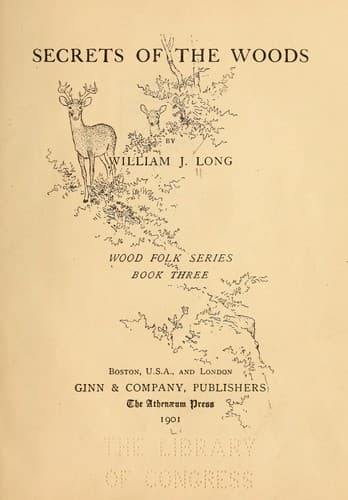
Secrets of the woodsLong, William J. (William Joseph)
History
Secrets of the woods
Long, William J. (William Joseph)
Animal behavior -- Juvenile literature; Natural history -- Juvenile literature; Zoology -- Juvenile literature
That is why he always dodges back after his first appearance; why he
gives you two or three swift glimpses of himself, now here, now there,
before coming out into the light. He knows his enemies are so hungry, so
afraid he will get away or that somebody else will catch him, that they
jump for him the moment he shows a whisker. So eager are they for his
flesh, and so sure, after missing him, that the swoop of wings or the
snap of red jaws has scared him into permanent hiding, that they pass on
to other trails. And when a prowler, watching from behind a stump, sees
Tookhees flash out of sight and hears his startled squeak, he thinks
naturally that the keen little eyes have seen the tail, which he forgot
to curl close enough, and so sneaks away as if ashamed of himself. Not
even the fox, whose patience is without end, has learned the wisdom of
waiting for Tookhees' second appearance. And that is the salvation of
the little 'Fraid One.
From all these enemies Tookhees has one refuge, the little arched nest
beyond the pretty doorway under the mossy stone. Most of his enemies
can dig, to be sure, but his tunnel winds about in such a way that they
never can tell from the looks of his doorway where it leads to;
and there are no snakes in the wilderness to follow and find out.
Occasionally I have seen where Mooween the bear has turned the stone
over and clawed the earth beneath; but there is generally a tough root
in the way, and Mooween concludes that he is taking too much trouble
for so small a mouthful, and shuffles off to the log where the red ants
live.
On his journeys through the woods Tookhees never forgets the dangerous
possibilities. His progress is a series of jerks, and whisks, and jumps,
and hidings. He leaves his doorway, after much watching, and shoots
like a minnow across the moss to an upturned root. There he sits up and
listens, rubbing his whiskers nervously. Then he glides along the root
for a couple of feet, drops to the ground and disappears. He is hiding
there under a dead leaf. A moment of stillness and he jumps like a
jack-in-abox. Now he is sitting on the leaf that covered him, rubbing
his whiskers again, looking back over his trail as if he heard footsteps
behind him. Then another nervous dash, a squeak which proclaims at once
his escape, and his arrival, and he vanishes under the old moss-grown
log where his fellows live, a whole colony of them.
All these things, and many more, I discovered the first season that I
began to study the wild things that lived within sight of my tent. I
had been making long excursions after bear and beaver, following on
wild-goose chases after Old Whitehead the eagle and Kakagos the wild
woods raven that always escaped me, only to find that within the warm
circle of my camp-fire little wild folk were hiding whose lives were
more unknown and quite as interesting as the greater creatures I had
been following.
Public-domain text, read in full here on John Shaqi.
Reviews
Reviews
No reviews yet
Be the first to share your thoughts on this work.
Join the Discussion
Join the discussion
Sign in to leave a comment or review.
Sign InorCreate an account