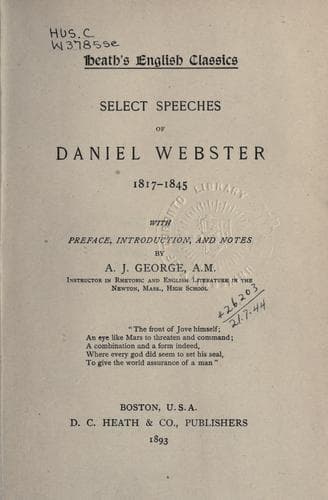
Select Speeches of Daniel Webster, 1817-1845Webster, Daniel
General
Select Speeches of Daniel Webster, 1817-1845
Webster, Daniel
Speeches, addresses, etc., American
No doubt, Sir, a great majority of the people of New England
conscientiously believed the embargo law of 1807 unconstitutional; [25]
as conscientiously, certainly, as the people of South Carolina hold
that opinion of the tariff. They reasoned thus: Congress has power to
regulate commerce; but here is a law, they said, stopping all commerce,
and stopping it indefinitely. The law is perpetual; that is, it is not
limited in point of time, and must of course continue until it shall be
repealed by some other law. It is as perpetual, therefore, as the law
against treason or murder. Now, is this regulating commerce, or
destroying it? Is it guiding, controlling, giving the rule to commerce,
as a subsisting thing or is it putting an end to it altogether? Nothing
is more certain, than that a majority in New England deemed this law a
violation of the Constitution. The very case required by the gentleman
to justify State interference had then arisen. Massachusetts believed
this law to be "a deliberate, palpable, and dangerous exercise of a
power not granted by the Constitution." Deliberate it was, for it was
long continued; palpable she thought it, as no words in the
Constitution gave the power, and only a construction, in her opinion
most violent, raised it; dangerous it was, since it threatened utter
ruin to her most important interests. Here, then, was a Carolina case.
How did Massachusetts deal with it? It was, as she thought, a plain,
manifest, palpable violation of the Constitution, and it brought ruin
to her doors. Thousands of families, and hundreds of thousands of
individuals, were beggared by it. While she saw and felt all this, she
saw and felt also, that, as a measure of national policy, it was
perfectly futile; that the country was no way benefited by that which
caused so much individual distress; that it was efficient only for the
production of evil, and all that evil inflicted on ourselves. In such a
case, under such circumstances, how did Massachusetts demean herself?
Sir, she remonstrated, she memorialized, she addressed herself to the
general government, not exactly "with the concentrated energy of
passion," but with her own strong sense, and the energy of sober
conviction. But she did not interpose the arm of her own power to
arrest the law, and break the embargo. Far from it. Her principles
bound her to two things; and she followed her principles, lead where
they might. First, to submit to every constitutional law of Congress,
and secondly, if the constitutional validity of the law be doubted, to
refer that question to the decision of the proper tribunals. The first
principle is vain and ineffectual without the second. A majority of us
in New England believed the embargo law unconstitutional; but the great
question was, and always will be in such cases, Who is to decide this?
Who is to judge between the people and the government? And, Sir, it is
quite plain, that the Constitution of the United States confers on the
Public-domain text, read in full here on John Shaqi.
Reviews
Reviews
No reviews yet
Be the first to share your thoughts on this work.
Elsewhere in the archive
Join the Discussion
Join the discussion
Sign in to leave a comment or review.
Sign InorCreate an account