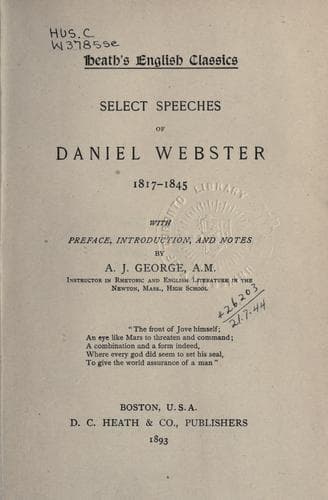
Select Speeches of Daniel Webster, 1817-1845Webster, Daniel
General
Select Speeches of Daniel Webster, 1817-1845
Webster, Daniel
Speeches, addresses, etc., American
government itself, to be exercised by its appropriate department, and
under its own responsibility to the people, this power of deciding
ultimately and conclusively upon the just extent of its own authority.
If this had not been done, we should not have advanced a single step
beyond the old Confederation.
Being fully of the opinion that the embargo law was unconstitutional,
the people of New England were yet equally clear in the opinion, (it
was a matter they did doubt upon,) that the question, after all, must
be decided by the judicial tribunals of the United States. Before those
tribunals, therefore, they brought the question. Under the provisions
of the law, they had given bonds to millions in amount, and which were
alleged to be forfeited. They suffered the bonds to be sued, and thus
raised the question. In the old-fashioned way of settling disputes,
they went to law. The case came to hearing and solemn argument; and he
who espoused their cause, and stood up for them against the validity of
the embargo act, was none other than that great man, of whom the
gentleman has made honorable mention, Samuel Dexter. He was then, Sir,
in the fulness of his knowledge, and the maturity of his strength. He
had retired from long and distinguished public service here, to the
renewed pursuit of professional duties, carrying with him all that
enlargement and expansion, all the new strength and force, which an
acquaintance with the more general subjects discussed in the national
councils is capable of adding to professional attainment, in a mind of
true greatness and comprehension. He was a lawyer, and he was also a
statesman. He had studied the Constitution, when he filled public
station, that he might defend it; he had examined its principles that
he might maintain them. More than all men, or at least as much as any
man, he was attached to the general government and to the union of the
States. His feelings and opinions all ran in that direction. A question
of constitutional law, too, was, of all subjects, that one which was
best suited to his talents and learning. Aloof from technicality, and
unfettered by artificial rule, such a question gave opportunity for
that deep and clear analysis, that mighty grasp of principle, which so
much distinguished his higher efforts. His very statement was argument;
his inference seemed demonstration. The earnestness of his own
conviction wrought conviction in others. One was convinced, and
believed, and assented, because it was gratifying, delightful, to
think, and feel, and believe, in unison with an intellect of such
evident superiority.
Public-domain text, read in full here on John Shaqi.
Reviews
Reviews
No reviews yet
Be the first to share your thoughts on this work.
Elsewhere in the archive
Join the Discussion
Join the discussion
Sign in to leave a comment or review.
Sign InorCreate an account