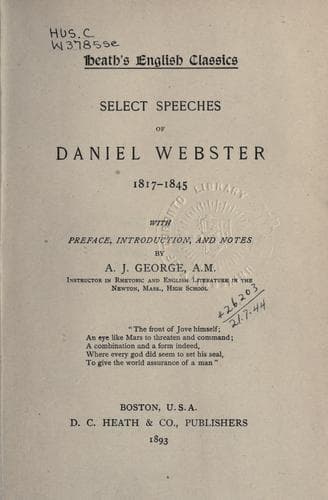
Select Speeches of Daniel Webster, 1817-1845Webster, Daniel
General
Select Speeches of Daniel Webster, 1817-1845
Webster, Daniel
Speeches, addresses, etc., American
But, Sir, the people have wisely provided, in the Constitution itself,
a proper, suitable mode and tribunal for settling questions of
constitutional law. There are in the Constitution grants of powers to
Congress, and restrictions on these powers. There are, also,
prohibitions on the States. Some authority must, therefore, necessarily
exist, having the ultimate jurisdiction to fix and ascertain the
interpretation of these grants, restrictions, and prohibitions. The
Constitution has itself pointed out, ordained, and established that
authority. How has it accomplished this great and essential end? By
declaring, Sir, that "_the Constitution, and the laws of the United
States made in pursuance thereof, shall be the supreme law of the land,
anything in the constitution or laws of any State to the contrary
notwithstanding_."
This, Sir, was the first great step. By this the supremacy of the
Constitution and laws of the United States is declared. The people so
will it. No State law is to be valid which comes in conflict with the
Constitution, or any law of the United States passed in pursuance of
it. But who shall decide this question of interference? To whom lies
the last appeal? This, Sir, the Constitution itself decides also, 25 by
declaring, "_that the judicial power shall extend to all cases arising
under the Constitution and laws of the United States_." These two
provisions cover the whole ground. They are, in truth, the keystone of
the arch! With these it is a government; without them it is a
confederation. In pursuance of these clear and express provisions,
Congress established, at its very first session, in the judicial act, a
mode for carrying them into full effect, and for bringing all questions
of constitutional power to the final decision of the Supreme Court. It
then, Sir, became a government. It then had the means of
self-protection; and but for this, it would, in all probability, have
been now among things which are past. Having constituted the
government, and declared its powers, the people have further said,
that, since somebody must decide on the extent of these powers, the
government shall itself decide; subject, always, like other popular
governments, to its responsibility to the people. And now, Sir, I
repeat, how is it that a State legislature acquires any power to
interfere? Who, or what, gives them the right to say to the people,
"We, who are your agents and servants for one purpose, will undertake
to decide, that your other agents and servants, appointed by you for
another purpose, have transcended the authority you gave them!" The
reply would be, I think, not impertinent, "Who made you a judge over
another's servants? To their own masters they stand or fall."
Public-domain text, read in full here on John Shaqi.
Reviews
Reviews
No reviews yet
Be the first to share your thoughts on this work.
Elsewhere in the archive
Join the Discussion
Join the discussion
Sign in to leave a comment or review.
Sign InorCreate an account