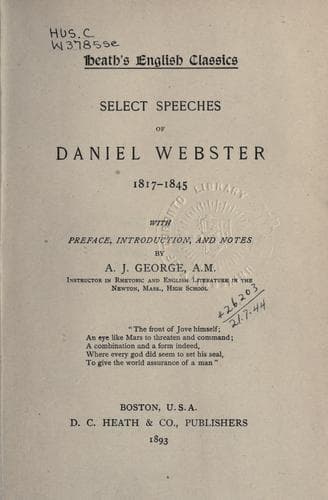
Select Speeches of Daniel Webster, 1817-1845Webster, Daniel
General
Select Speeches of Daniel Webster, 1817-1845
Webster, Daniel
Speeches, addresses, etc., American
Sir, I deny this power of State legislatures altogether. It cannot
stand the test of examination. Gentlemen may say, that, in an extreme
case, a State government might protect the people from intolerable
oppression. Sir, in such a case, the people might protect themselves,
without the aid of the State governments. Such a case warrants
revolution. It must make, when it comes, a law for itself. A nullifying
act of a State legislature cannot alter the case, nor make resistance
any more lawful. In maintaining these sentiments, Sir, I am but
asserting the rights of the people. I state what they have declared,
and insist on their right to declare it. They have chosen to repose
this power in the general government, and I think it my duty to support
it, like other constitutional powers.
For myself, Sir, I do not admit the competency of South Carolina, or
any other State, to prescribe my constitutional duty; or to settle,
between me and the people, the validity of laws of Congress for which I
have voted. I decline her umpirage. I have not sworn to support the
Constitution according to her construction of its clauses. I have not
stipulated, by my oath of office or otherwise, to come under any
responsibility, except to the people, and those whom they have
appointed to pass upon the question, whether laws, supported by my
votes, conform to the Constitution of the country. And, Sir, if we look
to the general nature of the case, could anything have been more
preposterous, than to make a government for the whole Union, and yet
leave its powers subject, not to one interpretation, but to thirteen or
twenty-four interpretations? Instead of one tribunal, established by
all, responsible to all, with power to decide for all, shall
constitutional questions be left to four-and-twenty popular bodies,
each at liberty to decide for itself, and none bound to respect the
decisions of others,--and each at liberty, too, to give a new
construction on every new election of its own members? Would anything,
with such a principle in it, or rather with such a destitution of all
principle, be fit to be called a government? No, Sir. It should not be
denominated a Constitution. It should be called, rather, a collection
of topics for everlasting controversy; heads of debate for a
disputatious people. It would not be a government. It would not be
adequate to any practical good, or fit for any country to live under.
Public-domain text, read in full here on John Shaqi.
Reviews
Reviews
No reviews yet
Be the first to share your thoughts on this work.
Elsewhere in the archive
Join the Discussion
Join the discussion
Sign in to leave a comment or review.
Sign InorCreate an account