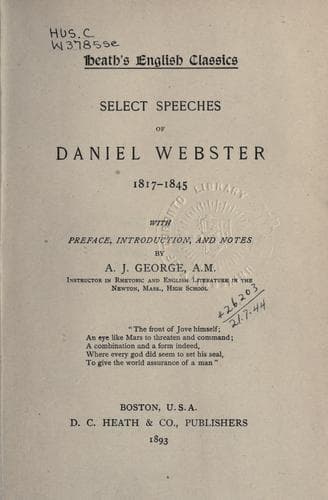
Select Speeches of Daniel Webster, 1817-1845Webster, Daniel
General
Select Speeches of Daniel Webster, 1817-1845
Webster, Daniel
Speeches, addresses, etc., American
To avoid all possibility of being misunderstood, allow me to repeat
again, in the fullest manner, that I claim no powers for the government
by forced or unfair construction. I admit that it is a government of
strictly limited powers; of enumerated, specified, and particularized
powers; and that whatsoever is not granted, is withheld. But
notwithstanding all this, and however the grant of powers may be
expressed, its limit and extent may yet, in some cases, admit of doubt;
and the general government would be good for nothing, it would be
incapable of long existing, if some mode had not been provided in which
those doubts, as they should arise, might be peaceably, but
authoritatively, solved.
And now, Mr. President, let me run the honorable gentleman's doctrine a
little into its practical application. Let us look at his probable
_modus operandi_. If a thing can be done, an ingenious man can tell how
it is to be done, and I wish to be informed how this State interference
is to be put in practice, without violence, bloodshed, and rebellion.
We will take the existing case of the tariff law. South Carolina is
said to have made up her opinion upon it. If we do not repeal it, (as
we probably shall not,) she will then apply to the case the remedy of
her doctrine. She will, we must suppose, pass a law of her legislature,
declaring the several acts of Congress usually called the tariff laws
null and void, so far as they respect South Carolina, or the citizens
thereof. So far, all is a paper transaction, and easy enough. But the
collector at Charleston is collecting the duties imposed by these
tariff laws. He, therefore, must be stopped. The collector will seize
the goods if the tariff duties are not paid. The State authorities will
undertake their rescue, the marshal, with his posse, will come to the
collector's aid, and here the contest begins. The militia of the State
will be called out to sustain the nullifying act. They will march, Sir,
under a very gallant leader; for I believe the honorable member himself
commands the militia of that part of the State. He will raise the
NULLIFYING ACT on his standard, and spread it out as his banner! It
will have a preamble, setting forth that the tariff laws are palpable,
deliberate, and dangerous violations of the Constitution! He will
proceed, with this banner flying, to the custom-house in Charleston,
"All the while
Sonorous metal blowing martial sounds." [26]
Arrived at the custom-house, he will tell the collector that he must
collect no more duties under any of the tariff laws. This he will be
somewhat puzzled to say, by the way, with a grave countenance,
considering what hand South Carolina herself had in that of 1816. But,
Sir, the collector would not, probably, desist, at his bidding. He
would show him the law of Congress, the treasury instruction, and his
own oath of office. He would say, he should perform his duty, come what
come might.
Public-domain text, read in full here on John Shaqi.
Reviews
Reviews
No reviews yet
Be the first to share your thoughts on this work.
Elsewhere in the archive
Join the Discussion
Join the discussion
Sign in to leave a comment or review.
Sign InorCreate an account