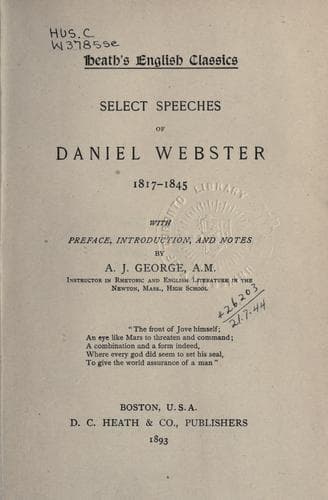
Select Speeches of Daniel Webster, 1817-1845Webster, Daniel
General
Select Speeches of Daniel Webster, 1817-1845
Webster, Daniel
Speeches, addresses, etc., American
Again, it is said that it was not thought of making Francis Knapp, the
prisoner at the bar, a PRINCIPAL till after the death of Richard
Crowningshield, Jr.; that the present indictment is an afterthought;
that "testimony was got up" for the occasion. It is not so. There is no
authority for this suggestion. The case of the Knapps had not then been
before the grand jury. The officers of the government did not know what
the testimony would be against them. They could not, therefore, have
determined what course they should pursue. They intended to arraign all
as principals who should appear to have been principals, and all as
accessories who should appear to have been accessories. All this could
be known only when the evidence should be produced. But the learned
counsel for the defendant take a somewhat loftier flight still. They
are more concerned, they assure us, for the law itself, than even for
their client. Your decision in this case, they say, will stand as a
precedent. Gentlemen, we hope it will. We hope it will be a precedent
both of candor and intelligence, of fairness and of firmness; a
precedent of good sense and honest purpose pursuing their investigation
discreetly, rejecting loose generalities, exploring all the
circumstances, weighing each, in search of truth, and embracing and
declaring the truth when found.
It is said, that "laws are made, not for the punishment of the guilty,
but for the protection of the innocent." This is not quite accurate,
perhaps, but if so, we hope they will be so administered as to give
that protection. But who are the innocent whom the law would protect?
Gentlemen, Joseph White was innocent. They are innocent who, having
lived in the fear of God through the day, wish to sleep in his peace
through the night, in their own beds. The law is established that those
who live quietly may sleep quietly; that they who do no harm may feel
none. The gentleman can think of none that are innocent except the
prisoner at the bar, not yet convicted. Is a proved conspirator to
murder innocent? Are the Crowningshields and the Knapps innocent? What
is innocence? How deep stained with blood, how reckless in crime, how
deep in depravity may it be, and yet remain innocence? The law is made,
if we would speak with entire accuracy, to protect the innocent by
punishing the guilty. But there are those innocent out of a court, as
well as in; innocent citizens not suspected of crime, as well as
innocent prisoners at the bar.
Public-domain text, read in full here on John Shaqi.
Reviews
Reviews
No reviews yet
Be the first to share your thoughts on this work.
Elsewhere in the archive
Join the Discussion
Join the discussion
Sign in to leave a comment or review.
Sign InorCreate an account