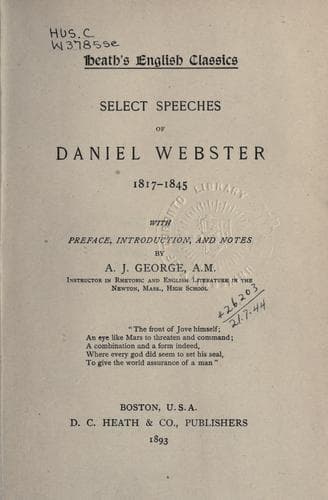
Select Speeches of Daniel Webster, 1817-1845Webster, Daniel
General
Select Speeches of Daniel Webster, 1817-1845
Webster, Daniel
Speeches, addresses, etc., American
The criminal law is not founded in a principle of vengeance. It does
not punish that it may inflict suffering. The humanity of the law feels
and regrets every pain it causes, every hour of restraint it imposes,
and more deeply still every life it forfeits. But it uses evil as the
means of preventing greater evil. It seeks to deter from crime by the
example of punishment. This is its true, and only true main object. It
restrains the liberty of the few offenders, that the many who do not
offend may enjoy their liberty. It takes the life of the murderer, that
other murders may not be committed. The law might open the jails, and
at once set free all persons accused of offences, and it ought to do so
if it could be made certain that no other offences would hereafter be
committed, because it punishes, not to satisfy any desire to inflict
pain, but simply to prevent the repetition of crimes. When the guilty,
therefore, are not punished, the law has so far failed of its purpose;
the safety of the innocent is so far endangered. Every unpunished
murder takes away something from the security of every man's life.
Whenever a jury, through whimsical and ill-founded scruples, suffer the
guilty to escape, they make themselves answerable for the augmented
danger of the innocent.
We wish nothing to be strained against this defendant. Why, then, all
this alarm? Why all this complaint against the manner in which the
crime is discovered? The prisoner's counsel catch at supposed flaws of
evidence, or bad character of witnesses, without meeting the case. Do
they mean to deny the conspiracy? Do they mean to deny that the two
Crowningshields and the two Knapps were conspirators? Why do they rail
against Palmer, while they do not disprove, and hardly dispute, the
truth of any one fact sworn to by him? Instead of this, it is made
matter of sentimentality that Palmer has been prevailed upon to betray
his bosom companions and to violate the sanctity of friendship. Again I
ask, Why do they not meet the case? If the fact is out, why not meet
it? Do they mean to deny that Captain White is dead? One would have
almost supposed even that, from some remarks that have been made. Do
they mean to deny the conspiracy? Or, admitting a conspiracy, do they
mean to deny only that Frank Knapp, the prisoner at the bar, was
abetting in the murder, being present, and so deny that he was a
principal? If a conspiracy is proved, it bears closely upon every
subsequent subject of inquiry. Why do they not come to the fact? Here
the defence is wholly indistinct. The counsel neither take the ground,
nor abandon it. They neither fly, nor light. They hover. But they must
come to a closer mode of contest. They must meet the facts, and either
deny or admit them. Had the prisoner at the bar, then, a knowledge of
this conspiracy or not? This is the question. Instead of laying out
their strength in complaining of the _manner_ in which the deed is
Public-domain text, read in full here on John Shaqi.
Reviews
Reviews
No reviews yet
Be the first to share your thoughts on this work.
Elsewhere in the archive
Join the Discussion
Join the discussion
Sign in to leave a comment or review.
Sign InorCreate an account