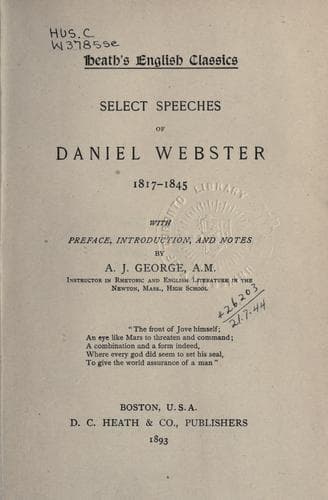
Select Speeches of Daniel Webster, 1817-1845Webster, Daniel
General
Select Speeches of Daniel Webster, 1817-1845
Webster, Daniel
Speeches, addresses, etc., American
discovered, of the extraordinary pains taken to bring the prisoner's
guilt to light, would it not be better to show there was no guilt?
Would it not be better to show his innocence? They say, and they
complain, that the community feel a great desire that he should be
punished for his crimes. Would it not be better to convince you that he
has committed no crime?
Gentlemen, let us now come to the case. Your first inquiry, on the
evidence, will be, Was Captain White murdered in pursuance of a
conspiracy, and was the defendant one of this conspiracy? If so, the
second inquiry is, Was he so connected with the murder itself as that
he is liable to be convicted as a _principal_? The defendant is
indicted as a _principal_. If not guilty _as such_, you cannot convict
him. The indictment contains three distinct classes of counts. In the
first, he is charged as having done the deed with his own hand; in the
second, as an aider and abettor to Richard Crowningshield, Jr., who did
the deed; in the third, as an aider and abettor to some person unknown.
If you believe him guilty on either of these counts, or in either of
these ways, you must convict him.
It may be proper to say, as a preliminary remark, that there are two
extraordinary circumstances attending this trial. One is, that Richard
Crowningshield, Jr., the supposed immediate perpetrator of the murder,
since his arrest, has committed suicide. He has gone to answer before a
tribunal of perfect infallibility. The other is, that Joseph Knapp, the
supposed originator and planner of the murder, having once made a full
disclosure of the facts, under a promise of indemnity, is,
nevertheless, not now a witness. Notwithstanding his disclosure and his
promise of indemnity, he now refuses to testify. He chooses to return
to his original state, and now stands answerable himself, when the time
shall come for his trial. These circumstances it is fit you should
remember, in your investigation of the case.
Your decision may affect more than the life of this defendant. If he be
not convicted as principal, no one can be. Nor can any one be convicted
of a participation in the crime as accessory. The Knapps and George
Crowningshield will be again on the community. This shows the
importance of the duty you have to perform, and serves to remind you of
the care and wisdom necessary to be exercised in its performance. But
certainly these considerations do not render the prisoner's guilt any
clearer, nor enhance the weight of the evidence against him. No one
desires you to regard consequences in that light. No one wishes any
thing to be strained, or too far pressed against the prisoner. Still,
it is fit you should see the full importance of the duty which devolves
upon you.[4] . . .
Public-domain text, read in full here on John Shaqi.
Reviews
Reviews
No reviews yet
Be the first to share your thoughts on this work.
Elsewhere in the archive
Join the Discussion
Join the discussion
Sign in to leave a comment or review.
Sign InorCreate an account