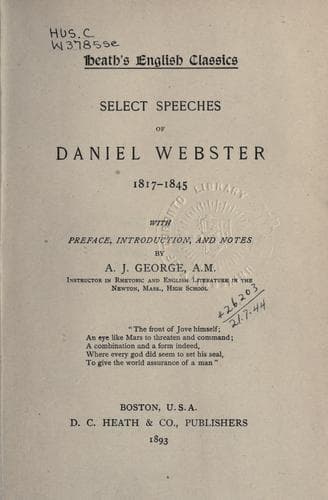
Select Speeches of Daniel Webster, 1817-1845Webster, Daniel
General
Select Speeches of Daniel Webster, 1817-1845
Webster, Daniel
Speeches, addresses, etc., American
The natural converse of _accession_ is _secession_; and, therefore,
when it is stated that the people of the States acceded to the Union,
it may be more plausibly argued that they may secede from it. If, in
adopting the Constitution, nothing was done but acceding to a compact,
nothing would seem necessary, in order to break it up, but to secede
from the same compact. But the term is wholly out of place.
_Accession_, as a word applied to political associations, implies
coming into a league, treaty, or confederacy, by one hitherto a
stranger to it; and _secession_ implies departing from such league or
confederacy. The people of the United States have used no such form of
expression in establishing the present government. They do not say that
they _accede_ to a league, but they declare that they _ordain_ and
_establish_ a Constitution. Such are the very words of the instrument
itself; and in all the States, without an exception, the language used
by their conventions was, that they "_ratified the Constitution_"; some
of them employing the additional words "assented to" and "adopted," but
all of them "ratifying."
There is more importance than may, at first sight, appear, in the
introduction of this new word, by the honorable mover of these
resolutions. Its adoption and use are indispensable to maintain those
premises from which his main conclusion is to be afterwards drawn. But
before showing that, allow me to remark, that this phraseology tends to
keep out of sight the just view of a previous political history, as
well as to suggest wrong ideas as to what was actually done when the
present Constitution was agreed to. In 1789, and before this
Constitution was adopted, the United States had already been in a
union, more or less close, for fifteen years. At least as far back as
the meeting of the first Congress, in 1774, they had been in some
measure, and for some national purposes, united together. Before the
Confederation of 1781, they had declared independence jointly, and had
carried on the war jointly, both by sea and land; and this not as
separate States, but as one people. When, therefore, they formed that
Confederation, and adopted its articles as articles of perpetual union,
they did not come together for the first time; and therefore they did
not speak of the States as _acceding_ to the Confederation, although it
was a league, and nothing but a league, and rested on nothing but
plighted faith for its performance. Yet, even then, the States were not
strangers to each other; there was a bond of union already subsisting
between them; they were associated, united States; and the object of
the Confederation was to make a stronger and better bond of union.
Their representatives deliberated together on these proposed Articles
of Confederation, and being authorized by their respective States,
finally "_ratified and confirmed_" them. Inasmuch as they were already
in union, they did not speak of _acceding_ to the new Articles of
Public-domain text, read in full here on John Shaqi.
Reviews
Reviews
No reviews yet
Be the first to share your thoughts on this work.
Elsewhere in the archive
Join the Discussion
Join the discussion
Sign in to leave a comment or review.
Sign InorCreate an account