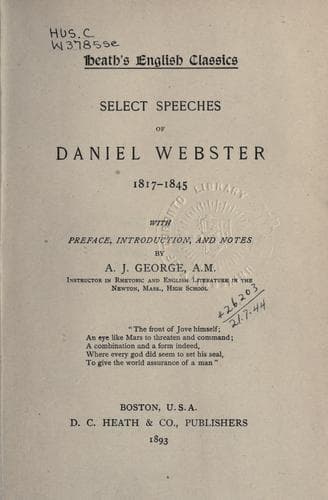
Select Speeches of Daniel Webster, 1817-1845Webster, Daniel
General
Select Speeches of Daniel Webster, 1817-1845
Webster, Daniel
Speeches, addresses, etc., American
Confederation, but of _ratifying_ and _confirming_ them; and this
language was not used inadvertently, because, in the same instrument,
_accession_ is used in its proper sense, when applied to Canada, which
was altogether a stranger to the existing union. "Canada," says the
eleventh article, "_acceding_ to this Confederation, and joining in the
measures of the United States, shall be admitted into the Union."
Having thus used the terms _ratify_ and _confirm_, even in regard to
the old Confederation, it would have been strange indeed, if the people
of the United States, after its formation, and when they came to
establish the present Constitution, had spoken of the States, or the
people of the States, as _acceding_ to this constitution. Such language
would have been ill-suited to the occasion. It would have implied an
existing separation or disunion among the States, such as never has
existed since 1774. No such language, therefore, was used. The language
actually employed is, _adopt, ratify, ordain, establish_.
Therefore, Sir, since any State, before she can prove her right to
dissolve the Union, must show her authority to undo what has been done,
no State is at liberty to _secede_, on the ground that she and other
States have done nothing but _accede_. She must show that she has a
right to _reverse_ what has been _ordained_, to _unsettle_ and
_overthrow_ what has been _established_, to _reject_ what the people
have _adopted_, and to breakup what have _ratified_; because these are
the terms which express the transactions which have actually taken
place. In other words, she must show her right to make a revolution.
If, Mr. President, in drawing these resolutions, the honorable member
and confined himself to the use of constitutional language, there would
have been a wide and awful _hiatus_ between his premises and his
conclusion. Leaving out the two words _compact_ and _accession_, which
are not constitutional modes of expression, and stating the matter
precisely as the truth is, his first resolution would have affirmed
that _the people of the several States ratified this Constitution, or
form of government_. These are the very words of South Carolina
herself, in her act of ratification. Let, then, his first resolution
tell the exact truth; let it state the fact precisely as it exists; let
it say that the people of the several States ratified a constitution,
or form of government, and then, Sir, what will become of his inference
in his second resolution, which is in these words, viz. "that, as in
all other cases of compact among sovereign parties, each has an equal
right to judge for itself, as well of the infraction as of the mode and
measure of redress"? It is obvious, is it not, Sir? that this
conclusion requires for its support quite other premises; it requires
premises which speak of _accession_ and of _compact_ between sovereign
powers; and, without such premises, it is altogether unmeaning.
Public-domain text, read in full here on John Shaqi.
Reviews
Reviews
No reviews yet
Be the first to share your thoughts on this work.
Elsewhere in the archive
Join the Discussion
Join the discussion
Sign in to leave a comment or review.
Sign InorCreate an account