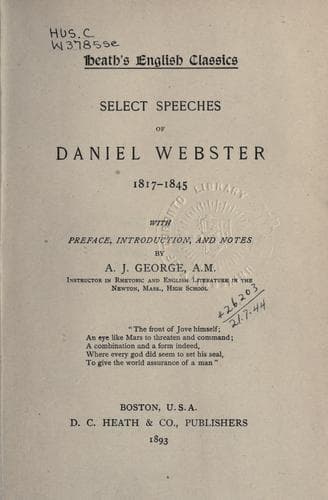
Select Speeches of Daniel Webster, 1817-1845Webster, Daniel
General
Select Speeches of Daniel Webster, 1817-1845
Webster, Daniel
Speeches, addresses, etc., American
But, Sir, while practical nullification in South Carolina would be, as
to herself, actual and distinct revolution, its necessary tendency must
also be to spread revolution, and to break up the Constitution, as to
all the other States. It strikes a deadly blow at the vital principle
of the whole Union. To allow State resistance to the laws of Congress
to be rightful and proper, to admit nullification in some States, and
yet not expect to see a dismemberment of the entire government, appears
to me the wildest illusion, and the most extravagant folly. The
gentleman seems not conscious of the direction or the rapidity of his
own course. The current of his opinions sweeps him along, he knows not
whither. To begin with nullification, with the avowed intent,
nevertheless, not to proceed to secession, dismemberment, and general
revolution, is as if one were to take the plunge of Niagara, and cry
out that he would stop half-way down. In the one case, as in the other,
the rash adventurer must go to the bottom of the dark abyss below, were
it not that that abyss has no discovered bottom.
Nullification, if successful, arrests the power of the law, absolves
citizens from their duty, subverts the foundation both of protection
and obedience, dispenses with oaths and obligations of allegiance, and
elevates another authority to supreme command. Is not this revolution?
And it raises to supreme command four-and-twenty distinct powers, each
professing to be under a general government, and yet each setting its
laws at defiance at pleasure. Is not this anarchy, as well as
revolution? Sir, the Constitution of the United States was received as
a whole, and for the whole country. If it cannot stand altogether, it
cannot stand in parts; and if the laws cannot be executed everywhere,
they cannot long be executed anywhere. The gentleman very well knows
that all duties and imposts must be uniform throughout the country. He
knows that we cannot have one rule or one law for South Carolina, and
another for other States. He must see, therefore, and does see, and
every man sees, that the only alternative is a repeal of the laws
throughout the whole Union, or their execution in Carolina as well as
elsewhere. And this repeal is demanded because a single State
interposes her veto, and threatens resistance! The result of the
gentleman's opinion, or rather the very text of his doctrine, is, that
no act of Congress can bind all the States, the constitutionality of
which is not admitted by all; or, in other words, that no single State
is bound, against its own dissent, by a law of imposts. This is
precisely the evil experienced under the old Confederation, and for
remedy of which this Constitution was adopted. The leading object in
establishing this government, an object forced on the country by the
conditions of the times and the absolute necessity of the law, was to
give to Congress power to lay and collect imposts _without the consent
of particular States_.
Public-domain text, read in full here on John Shaqi.
Reviews
Reviews
No reviews yet
Be the first to share your thoughts on this work.
Elsewhere in the archive
Join the Discussion
Join the discussion
Sign in to leave a comment or review.
Sign InorCreate an account