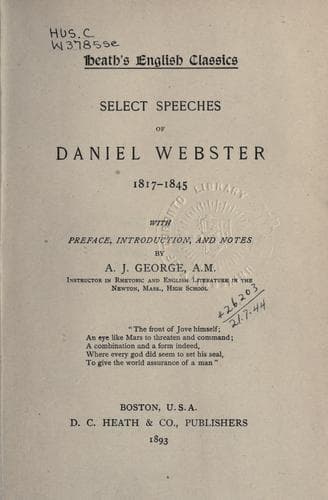
Select Speeches of Daniel Webster, 1817-1845Webster, Daniel
General
Select Speeches of Daniel Webster, 1817-1845
Webster, Daniel
Speeches, addresses, etc., American
The Constitution does not provide for events which must be preceded by
its own destruction. SECESSION, therefore, since it must bring these
consequences with it, is REVOLUTIONARY, and NULLIFICATION is equally
REVOLUTIONARY. What is revolution? Why, Sir, that is revolution which
overturns, or controls, or successfully resists, the existing public
authority; that which arrests the exercise of the supreme power; that
which introduces a new paramount authority into the rule of the State.
Now, Sir, this is the precise object of nullification. It attempts to
supersede the supreme legislative authority. It arrests the arm of the
executive magistrate. It interrupts the exercise of the accustomed
judicial power. Under the name of an ordinance, it declares null and
void, within the State, all the revenue laws of the United States. Is
not this revolutionary? Sir, so soon as this ordinance shall be carried
into effect, a _revolution_ will have commenced in South Carolina. She
will have thrown off the authority to which her citizens have
heretofore been subject. She will have declared her own opinions and
her own will to be above the laws and above the power of those who are
intrusted with their administration. If she makes good these
declarations, she is revolutionized. As to her, it is as distinctly a
change of the supreme power as the American Revolution of 1776. That
revolution did not subvert government in all its forms. It did not
subvert local laws and municipal administrations. It only threw off the
dominion of a power claiming to be superior, and to have a right, in
many important respects, to exercise legislative authority. Thinking
this authority to have been usurped or abused, the American Colonies,
now the United States, bade it defiance, and freed themselves from it
by means of a revolution. But that revolution left them with their own
municipal laws still, and the forms of local government. If Carolina
now shall effectually resist the laws of Congress; if she shall be her
own judge, take her remedy into her own hands, obey the laws of the
Union when she pleases and disobey them when she pleases, she will
relieve herself from a paramount power as distinctly as the American
Colonies did the same thing in 1776. In other words, she will achieve,
as to herself, a revolution.
Public-domain text, read in full here on John Shaqi.
Reviews
Reviews
No reviews yet
Be the first to share your thoughts on this work.
Elsewhere in the archive
Join the Discussion
Join the discussion
Sign in to leave a comment or review.
Sign InorCreate an account