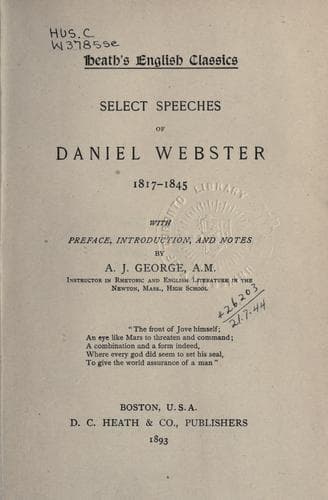
Select Speeches of Daniel Webster, 1817-1845Webster, Daniel
General
Select Speeches of Daniel Webster, 1817-1845
Webster, Daniel
Speeches, addresses, etc., American
Mr. President, the alleged right of a State to decide constitutional
questions for herself necessarily leads to force because other States
must have the same right, and because different States will decide
differently; and when these questions arise between States, if there be
no superior power, they can be decided only by the law of force. On
entering into the Union, the people of each State gave up a part of
their own power to make laws for themselves, in consideration, that, as
to common objects, they should have a part in making laws for other
States. In other words, the people of all the States agreed to create a
common government, to be conducted by common counsels. Pennsylvania,
for example, yielded the right of laying imposts in her own ports, in
consideration that the new government, in which she was to have a
share, should possess the power of laying imposts on all the States. If
South Carolina now refuses to submit to this power, she breaks the
condition on which other States entered into the Union. She partakes of
the common counsels, and therein assists to bind others, while she
refuses to be bound herself. It makes no difference in the case whether
she does all this without reason or pretext, or whether she sets up as
a reason, that, in her judgment, the acts complained of are
unconstitutional. In the judgment of other States, they are not so. It
is nothing to them that she offers some reason or some apology for her
conduct, if it be one which they do not admit. It is not to be expected
that any State will violate her duty without some plausible pretext.
That would be too rash a defiance of the opinion of mankind. But if it
be a pretext which lies in her own breast, if it be no more than an
opinion which she says she has formed, how can other States be
satisfied with this? How can they allow her to be judge of her own
obligations? Or, if she may judge of her obligations, may they not
judge of their rights also? May not the twenty-three entertain an
opinion as well as the twenty-fourth? And if it be their right, in
their own opinion, as expressed in the common council, to enforce the
law against her, how is she to say that her right and her opinion are
to be every thing, and their right and their opinion nothing?
Public-domain text, read in full here on John Shaqi.
Reviews
Reviews
No reviews yet
Be the first to share your thoughts on this work.
Elsewhere in the archive
Join the Discussion
Join the discussion
Sign in to leave a comment or review.
Sign InorCreate an account