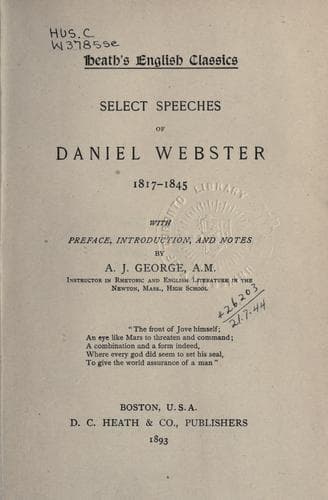
Select Speeches of Daniel Webster, 1817-1845Webster, Daniel
General
Select Speeches of Daniel Webster, 1817-1845
Webster, Daniel
Speeches, addresses, etc., American
Mr. President, if we are to receive the Constitution as the text, and
then to lay down in its margin the contradictory commentaries which
have been, and which may be, made by different States, the whole page
would be a polyglot indeed. It would speak with as many tongues as the
builders of Babel, and in dialects as much confused, and mutually as
unintelligible. The very instance now before us presents a practical
illustration. The law of the last session is declared unconstitutional
in South Carolina, and in obedience to it is refused. In other States,
it is admitted to be strictly constitutional. You walk over the limit
of its authority, therefore, when you pass a State line. On one side it
is law, on the other side a nullity; and yet it is passed by a common
government, having the same authority in all the States.
Such, Sir, are the inevitable results of this doctrine. Beginning with
the original error, that the Constitution of the United States is
nothing but a compact between sovereign States; asserting, in the next
step, that each State has a right to be its own sole judge of the
extent of its own obligations, and consequently of the
constitutionality of laws of Congress; and, in the next, that it may
oppose whatever it sees fit to declare unconstitutional, and that it
decides for itself on the mode and measure of redress,--the argument
arrives at once at the conclusion, that what a State dissents from, it
may nullify; what it opposes, it may oppose by force; what it decides
for itself, it may execute by its own power; and that, in short, it is
itself supreme over the legislation of Congress, and supreme over the
decisions of the national judicature; supreme over the constitution of
the country, supreme over the supreme law of the land. However it seeks
to protect itself against these plain inferences, by saying that an
unconstitutional law is no law, and that it only opposes such laws as
are unconstitutional, yet this does not in the slightest degree vary
the result; since it insists on deciding this question for itself; and,
in opposition to reason and argument, in opposition to practice and
experience, in opposition to the judgment of others, having an equal
right to judge, it says, only, "Such is my opinion, and my opinion
shall be my law, and I will support it by my own strong hand. I
denounce the law; I declare it unconstitutional; that is enough; it
shall not be executed. Men in arms are ready to resist its execution.
An attempt to enforce it shall cover the land with blood. Elsewhere it
may be binding; but here it is trampled under foot." This, Sir, is
practical nullification.
And now, Sir, against all these theories and opinions, I maintain,--
1. That the Constitution of the United States is not a league,
confederacy, or compact between the people of the several States in
their sovereign capacities; but a government proper, founded on the
adoption of the people, and creating direct relations between itself
and individuals.
Public-domain text, read in full here on John Shaqi.
Reviews
Reviews
No reviews yet
Be the first to share your thoughts on this work.
Elsewhere in the archive
Join the Discussion
Join the discussion
Sign in to leave a comment or review.
Sign InorCreate an account