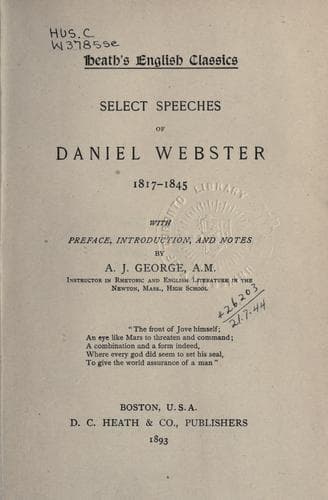
Select Speeches of Daniel Webster, 1817-1845Webster, Daniel
General
Select Speeches of Daniel Webster, 1817-1845
Webster, Daniel
Speeches, addresses, etc., American
regulation which determines the manner in which the public authority is
to be executed, is what forms the _constitution_ of a state. Those
primary rules which concern the body itself, and the very being of the
political society, the form of government, and the manner in which
power is to be exercised,--all, in a word, which form together the
_constitution of a state_,--these are the fundamental laws. This, Sir,
is the language of the public writers. But do we need to be informed,
in this country, what a _constitution_ is? Is it not an idea perfectly
familiar, definite, and settled? We are at no loss to understand what
is meant by the constitution of one of the States; and the Constitution
of the United States speaks of itself as being an instrument of the
same nature. It says this _Constitution_ shall be the law of the land,
anything in any State _constitution_ to the contrary notwithstanding.
And it speaks of itself, too, in plain contradistinction from a
confederation; for it says that all debts contracted, and all
engagements entered into, by the United States, shall be as valid under
this _Constitution_ as under the _Confederation_. It does not say, as
valid under this _compact_, or this league, or this confederation, as
under the former confederation, but as valid under this _Constitution_.
This, then, Sir, is declared to be a _constitution_. A constitution is
the fundamental law of the state; and this is expressly declared to be
the supreme law. It is as if the people had said, "We prescribe this
fundamental law," or "this supreme law," for they do say that they
establish this Constitution, and that it shall be the supreme law. They
say that they _ordain and establish_ it. Now, Sir, what is the common
application of these words? We do not speak of ordaining leagues and
compacts. If this was intended to be a compact or league, and the
States to be parties to it, why was it not so said? Why is there found
no one expression in the whole instrument indicating such intent? The
old Confederation was expressly called a _league_, and into this league
it was declared that the States, as States, severally entered. Why was
not similar language used in the Constitution, if a similar intention
had existed? Why was it not said, "the States enter into this new
league," "the States form this new confederation," or "the States agree
to this new compact"? Or why was it not said, in the language of the
gentleman's resolution, that the people of the several States acceded
to this compact in their sovereign capacities? What reason is there for
supposing that the framers of the Constitution rejected expressions
appropriate to their own meaning, and adopted others wholly at war with
that meaning?
Public-domain text, read in full here on John Shaqi.
Reviews
Reviews
No reviews yet
Be the first to share your thoughts on this work.
Elsewhere in the archive
Join the Discussion
Join the discussion
Sign in to leave a comment or review.
Sign InorCreate an account