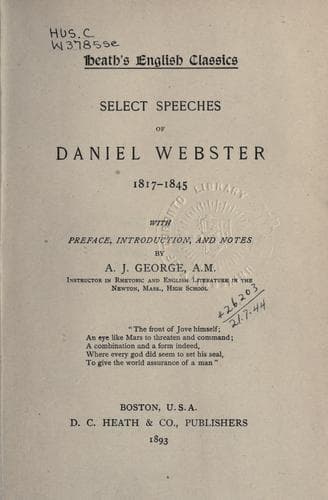
Select Speeches of Daniel Webster, 1817-1845Webster, Daniel
General
Select Speeches of Daniel Webster, 1817-1845
Webster, Daniel
Speeches, addresses, etc., American
Again, Sir, the Constitution speaks of that political system which is
established as "the government of the United States." Is it not doing
strange violence to language to call a league or a compact between
sovereign powers a _government_? The government of a state is that
organization in which the political power resides. It is the political
being created by the constitution or fundamental law. The broad and
clear difference between a government and a league or compact is, that
a government is a body politic; it has a will of its own; and it
possesses powers and faculties to execute its own purposes. Every
compact looks to some power to enforce its stipulations. Even in a
compact between sovereign communities, there always exists this
ultimate reference to a power to insure its execution; although, in
such case, this power is but the force of one party against the force
of another; that is to say, the power of war. But a _government_
executes its decisions by its own supreme authority. Its use of force
in compelling obedience to its own enactments is not war. It
contemplates no opposing party having a right of resistance. It rests
on its own power to enforce its own will; and when it ceases to possess
this power, it is no longer a government.
Mr. President, I concur so generally to the very able speech of the
gentleman from Virginia near me [1], that it is not without diffidence
and regret that I venture to differ with him on any point. His
opinions, Sir, are redolent of the doctrines of a very distinguished
school, for which I have the highest regard, of whose doctrines I can
say, what I can also say of the gentleman's speech, that, while I
concur in the results, I must be permitted to hesitate about some of
the premises. I do not agree that the Constitution is a compact between
States in their sovereign capacities. I do not agree, that, in
strictness of language, it is a compact at all. But I do agree that it
is founded on consent or agreement, or on compact, if the gentleman
prefers that word, and means no more by it than voluntary consent or
agreement. The Constitution, Sir, is not a contract, but the result of
a contract; meaning by contract no more than assent. Founded on
consent, it is a government proper. Adopted by the agreement of the
people of the United States, when adopted, it has become a
Constitution. The people have agreed to make a Constitution; but when
made, that Constitution becomes what its name imports. It is no longer
a mere agreement. Our laws, Sir, have their foundation in the agreement
or consent of the two houses of Congress. We say, habitually, that one
house proposes a bill, and the other agrees to it; but the result of
this agreement is not a compact, but a law. The law, the statute, is
not the agreement, but something created by the agreement; and
something which, when created, has a new character, and acts by its own
authority. So the Constitution of the United States, founded in or on
Public-domain text, read in full here on John Shaqi.
Reviews
Reviews
No reviews yet
Be the first to share your thoughts on this work.
Elsewhere in the archive
Join the Discussion
Join the discussion
Sign in to leave a comment or review.
Sign InorCreate an account