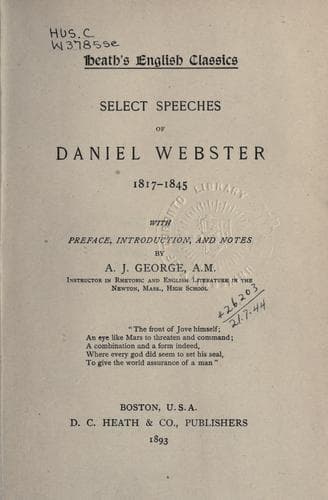
Select Speeches of Daniel Webster, 1817-1845Webster, Daniel
General
Select Speeches of Daniel Webster, 1817-1845
Webster, Daniel
Speeches, addresses, etc., American
On the other hand, the government owes high and solemn duties to every
citizen of the country. It is bound to protect him in his most
important rights and interests. It makes war for his protection, and no
other government in the country can make war. It makes peace for his
protection, and no other government can make peace. It maintains armies
and navies for his defence and security, and no other government is
allowed to maintain them. He goes abroad beneath its flag, and carries
over all the earth a national character imparted to him by this
government, and which no other government can impart. In whatever
relates to war, to peace, to commerce, he knows no other government.
All these, Sir, are connections as dear and as sacred as can bind
individuals to any government on earth. It is not, therefore, a compact
between States, but a government proper, operating directly upon
individuals, yielding to them protection on the one hand, and demanding
from them obedience on the other.
There is no language in the whole Constitution applicable to a
confederation of States. If the States be parties, as States, what are
their rights, and what their respective covenants and stipulations? And
where are their rights, covenants, and stipulations expressed? The
States engage for nothing, they promise nothing. In the Articles of
Confederation, they did make promises, and did enter into engagements,
and did plight the faith of each State for their fulfilment; but In the
Constitution there is nothing of that kind. The reason is, that, in the
Constitution, it is the _people_ who speak, and not the States. The
people ordain the Constitution, and therein address themselves to the
States, and to the legislatures of the States, in the language of
injunction and prohibition. The Constitution utters its behests in the
name and by authority of the people, and it does not exact from States
any plighted public faith to maintain it. On the contrary, it makes its
own preservation depend on individual duty and individual obligation.
Sir, the States cannot omit to appoint Senators and Electors. It is not
a matter resting in State discretion or State pleasure. The
Constitution has taken better care of its own preservation. It lays its
hand on individual conscience and individual duty. It incapacitates any
man to sit in the legislature of a State who shall not first have taken
his solemn oath to support the Constitution of the United States. From
the obligation of this oath no State power can discharge him. All the
members of all the State legislatures are as religiously bound to
support the Constitution of the United States as they are to support
their own State constitution. Nay, Sir, they are as solemnly sworn to
support it as we ourselves are, who are members of Congress.
Public-domain text, read in full here on John Shaqi.
Reviews
Reviews
No reviews yet
Be the first to share your thoughts on this work.
Elsewhere in the archive
Join the Discussion
Join the discussion
Sign in to leave a comment or review.
Sign InorCreate an account