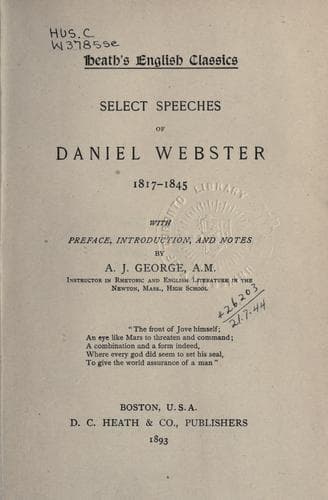
Select Speeches of Daniel Webster, 1817-1845Webster, Daniel
General
Select Speeches of Daniel Webster, 1817-1845
Webster, Daniel
Speeches, addresses, etc., American
No member of a State legislature can refuse to proceed, at the proper
time, to elect Senators to Congress, or to provide for the choice of
Electors of President and Vice-President, any more than the members of
this Senate can refuse, when the appointed day arrives, to meet the
members of the other house, to count the votes for those officers, and
ascertain who are chosen. In both cases, the duty binds, and with equal
strength, the conscience of the individual member, and it is imposed on
all by an oath in the same words. Let it then never be said, Sir, that
it is a matter of discretion with the States whether they will continue
the government, or break it up by refusing to appoint Senators and to
elect Electors. They have no discretion in the matter. The members of
their legislatures cannot avoid doing either, so often as the time
arrives, without a direct violation of their duty and their oaths; such
a violation as would break up any other government.
Looking still further to the provisions of the Constitution itself, in
order to learn its true character, we find its great apparent purpose
to be, to unite the people of all the States under one general
government, for certain definite objects, and, to the extent of this
union, to restrain the separate authority of the States. Congress only
can declare war; therefore, when one State is at war with a foreign
nation, all must be at war. The President and the Senate only can make
peace; when peace is made for one State, therefore, it must be made for
all.
Can anything be conceived more preposterous, than that any State should
have power to nullify the proceedings of the general government
respecting peace and war? When war is declared by a law of Congress,
can a single State nullify that law, and remain at peace? And yet she
may nullify that law as well as any other. If the President and Senate
make peace, may one State, nevertheless, continue the war? And yet, if
she can nullify a law, she may quite as well nullify a treaty.
The truth is, Mr. President, and no ingenuity of argument, no subtilty
of distinction can evade it, that, as to certain purposes, the people
of the United States are one people. They are one in making war, and
one in making peace; they are one in regulating commerce, and one in
laying duties of imposts. The very end and purpose of the Constitution
was, to make them one people in these particulars; and it has
effectually accomplished its object. All this is apparent on the face
of the Constitution itself. I have already said, Sir, that to obtain a
power of direct legislation over the people, especially in regard to
imposts, was always prominent as a reason for getting rid of the
Confederation, and forming a new Constitution. Among innumerable proofs
of this, before the assembling of the Convention, allow me to refer
only to the report of the committee of the old Congress, July, 1785.
Public-domain text, read in full here on John Shaqi.
Reviews
Reviews
No reviews yet
Be the first to share your thoughts on this work.
Elsewhere in the archive
Join the Discussion
Join the discussion
Sign in to leave a comment or review.
Sign InorCreate an account