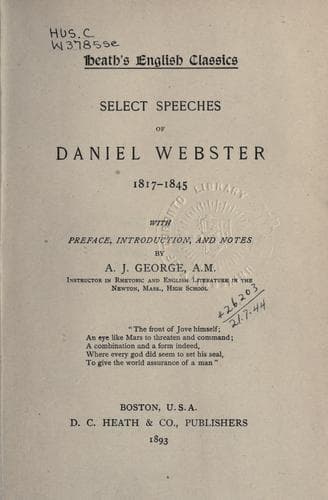
Select Speeches of Daniel Webster, 1817-1845Webster, Daniel
General
Select Speeches of Daniel Webster, 1817-1845
Webster, Daniel
Speeches, addresses, etc., American
Indeed, Sir, if we look to all contemporary history, to the numbers of
the Federalist, to the debates in the conventions, to the publications
of friends and foes, they all agree, that a change had been made from a
confederacy of States to a different system; they all agree, that the
Convention had formed a Constitution for a national government. With
this result some were satisfied, and some were dissatisfied; but all
admitted that the thing had been done. In none of these various
productions and publications did any one intimate that the new
Constitution was but another compact between States in their sovereign
capacities. I do not find such an opinion advanced in a single
instance. Everywhere, the people were told that the old Confederation
was to be abandoned, and a new system to be tried; that a proper
government was proposed, to be founded in the name of the people, and
to have a regular organization of its own. Everywhere, the people were
told that it was to be a government with direct powers to make laws
over individuals, and to lay taxes and imposts without the consent of
the States. Everywhere, it was understood to be a popular Constitution.
It came to the people for their adoption, and was to rest on the same
deep foundation as the State constitutions themselves. Its most
distinguished advocates, who had been themselves members of the
Convention, declared that the very object of submitting the
Constitution to the people was, to preclude the possibility of its
being regarded as a mere compact. "However gross a heresy," say the
writers of the Federalist, "it may be to maintain that a party to a
_compact_ has a right to revoke that _compact_, the doctrine itself has
had respectable advocates. The possibility of a question of this nature
proves the necessity of laying the foundations of our national
government deeper than in the mere sanction of delegated authority. The
fabric of American empire ought to rest on the solid basis of THE
CONSENT OF THE PEOPLE."
Such is the language, Sir, addressed to the people, while they yet had
the Constitution under consideration. The powers conferred on the new
government were perfectly well understood to be conferred, not by any
State, or the people of any State, but by the people of the United
States. Virginia is more explicit, perhaps, in this particular, than
any other State. Her convention, assembled to ratify the Constitution,
"in the name and behalf of the people of Virginia, declare and make
known, that the powers granted under the Constitution, _being derived
from the people of the United States_, may be resumed by them whenever
the same shall be perverted to their injury or oppression."
Is this language which describes the formation of a compact between
States? or language describing the grant of powers to a new government,
by the whole people of the United States?
Public-domain text, read in full here on John Shaqi.
Reviews
Reviews
No reviews yet
Be the first to share your thoughts on this work.
Elsewhere in the archive
Join the Discussion
Join the discussion
Sign in to leave a comment or review.
Sign InorCreate an account