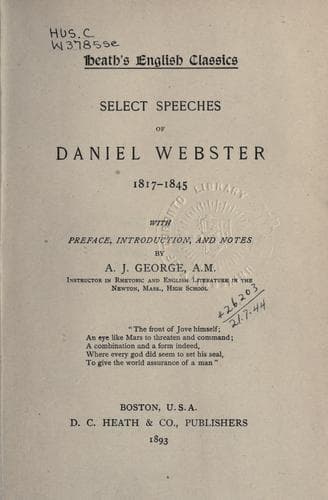
Select Speeches of Daniel Webster, 1817-1845Webster, Daniel
General
Select Speeches of Daniel Webster, 1817-1845
Webster, Daniel
Speeches, addresses, etc., American
Among all the other ratifications, there is not one which speaks of the
Constitution as a compact between States. Those of Massachusetts and
New Hampshire express the transaction, in my opinion, with sufficient
accuracy. They recognize the Divine goodness "in affording THE PEOPLE
OF THE UNITED STATES an opportunity of entering into an explicit and
solemn compact with each other _by assenting to and ratifying a new
Constitution_." You will observe, Sir, that it is the PEOPLE, and not
the States, who have entered into this compact; and it is the PEOPLE of
all the United States. These conventions, by this form of expression,
meant merely to say, that the people of the United States had, by the
blessing of Providence, enjoyed the opportunity of establishing a new
Constitution, _founded in the consent of the people_. This consent of
the people has been called, by European writers, the _social compact_;
and, in conformity to this common mode of expression, these conventions
speak of that assent, on which the new Constitution was to rest, as an
explicit and solemn compact, not which the States had entered into with
each other, but which the _people_ of the United States had entered
into.
Finally, Sir, how can any man get over the words of the Constitution
itself?--"WE, THE PEOPLE OF THE UNITED STATES, DO ORDAIN AND ESTABLISH
THIS CONSTITUTION." These words must cease to be a part of the
Constitution, they must be obliterated from the parchment on which they
are written, before any human ingenuity or human argument can remove
the popular basis on which that Constitution rests, and turn the
instrument into a mere compact between sovereign States.
The second proposition, Sir, which I propose to maintain, is, that no
State authority can dissolve the relations subsisting between the
government of the United States and individuals; that nothing can
dissolve these relations but revolution; and that, therefore, there can
be no such thing as _secession_ without revolution. All this follows,
as it seems to me, as a just consequence, if it be first proved that
the Constitution of the United States is a government proper, owing
protection to individuals, and entitled to their obedience.
Public-domain text, read in full here on John Shaqi.
Reviews
Reviews
No reviews yet
Be the first to share your thoughts on this work.
Elsewhere in the archive
Join the Discussion
Join the discussion
Sign in to leave a comment or review.
Sign InorCreate an account