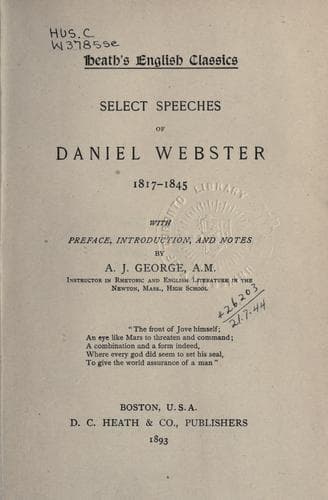
Select Speeches of Daniel Webster, 1817-1845Webster, Daniel
General
Select Speeches of Daniel Webster, 1817-1845
Webster, Daniel
Speeches, addresses, etc., American
If this vehement invective against _majorities_ meant no more than
that, in the construction of government, it is wise to provide checks
and balances, so that there should be various limitations on the power
of the mere majority, it would only mean what the Constitution of the
United States has already abundantly provided. It is full of such
checks and balances. In its very organization, it adopts a broad and
most effective principle in restraint of the power of mere majorities.
A majority of the people elects the House of Representatives, but it
does not elect the Senate. The Senate is elected by the States, each
State having, in this respect, an equal power. No law, therefore, can
pass, without the assent of the representatives of the people, and a
majority of the representatives of the States also. A majority of the
representatives of the people must concur, and a majority of the States
must concur, in every act of Congress; and the President is elected on
a plan compounded of both these principles. But having composed one
house of representatives chosen by the people in each State, according
to their numbers, and the other of an equal number of members from
every State, whether larger or smaller, the Constitution gives to
majorities in these houses thus constituted the full and entire power
of passing laws, subject always to the constitutional restrictions and
to the approval of the President. To subject them to any other power is
clear usurpation. The majority of one house may be controlled by the
majority of the other; and both may be restrained by the President's
negative. These are checks and balances provided by the Constitution,
existing in the government itself, and wisely intended to secure
deliberation and caution in legislative proceedings. But to resist the
will of the majority in both houses, thus constitutionally exercised;
to insist on the lawfulness of interposition by an extraneous power; to
claim the right of defeating the will of Congress, by setting up
against it the will of a single State,--is neither more nor less, as it
strikes me, than a plain attempt to overthrow the government. The
constituted authorities of the United States are no longer a
government, if they be not masters of their own will; they are no
longer a government, if an external power may arrest their proceedings;
they are no longer a government, if acts passed by both houses, and
approved by the President, may be nullified by State vetoes or State
ordinances. Does any one suppose it could make any difference, as to
the binding authority of an act of Congress, and of the duty of a State
to respect it, whether it passed by a mere majority of both houses, or
by three fourths of each, or the unanimous vote of each? Within the
limits and restrictions of the Constitution, the government of the
United States, like all other popular governments, acts by majorities.
It can act no otherwise. Whoever, therefore, denounces the government
Public-domain text, read in full here on John Shaqi.
Reviews
Reviews
No reviews yet
Be the first to share your thoughts on this work.
Elsewhere in the archive
Join the Discussion
Join the discussion
Sign in to leave a comment or review.
Sign InorCreate an account