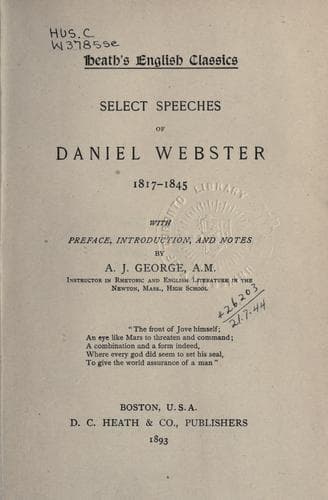
Select Speeches of Daniel Webster, 1817-1845Webster, Daniel
General
Select Speeches of Daniel Webster, 1817-1845
Webster, Daniel
Speeches, addresses, etc., American
exercise of this appellate power of the Supreme Court, in all the
proper cases, in whatsoever court arising; and this appellate power has
now been exercised for more than forty years, without interruption, and
without doubt.
As to the cases, Sir, which do not come before the courts, those
political questions which terminate with the enactments of Congress, it
is of necessity that these should be ultimately decided by Congress
itself. Like other legislatures, it must be trusted with this power.
The members of Congress are chosen by the people, and they are
answerable to the people; like other public agents, they are bound by
oath to support the Constitution. These are the securities that they
will not violate their duty, nor transcend their powers. They are the
same securities that prevail in other popular governments; nor is it
easy to see how grants of power can be more safely guarded, without
rendering them nugatory. If the case cannot come before the courts, and
if Congress be not trusted with its decision, who shall decide it? The
gentleman says, each State is to decide it for herself. If so, then, as
I have already urged, what is law in one State is not law in another.
Or, if the resistance of one State compels an entire repeal of the law,
then a minority, and that a small one, governs the whole country.
Sir, those who espouse the doctrines of nullification reject, as it
seems to me, the first great principle of all republican liberty; that
is, that the majority _must_ govern. In matters of common concern, the
judgment of a majority _must_ stand as the judgment of the whole. This
is a law imposed on us by the absolute necessity of the case; and if we
do not act upon it, there is no possibility of maintaining any
government but despotism. We hear loud and repeated denunciations
against what is called _majority government_. It is declared, with much
warmth, that a majority government cannot be maintained in the United
States. What, then, do gentlemen wish? Do they wish to establish a
_minority_ government? Do they wish to subject the will of the many to
the will of the few? The honorable gentleman from South Carolina has
spoken of absolute majorities and majorities concurrent; language
wholly unknown to our Constitution, and to which it is not easy to
affix definite ideas. As far as I understand it, it would teach us that
the absolute majority may be found in Congress, but the majority
concurrent must be looked for in the States; that is to say, Sir,
stripping the matter of this novelty of phrase, that the dissent of one
or more States, as States, renders void the decision of a majority of
Congress, so far as that State is concerned. And so this doctrine,
running but a short career, like other dogmas of the day, terminates in
nullification.
Public-domain text, read in full here on John Shaqi.
Reviews
Reviews
No reviews yet
Be the first to share your thoughts on this work.
Elsewhere in the archive
Join the Discussion
Join the discussion
Sign in to leave a comment or review.
Sign InorCreate an account