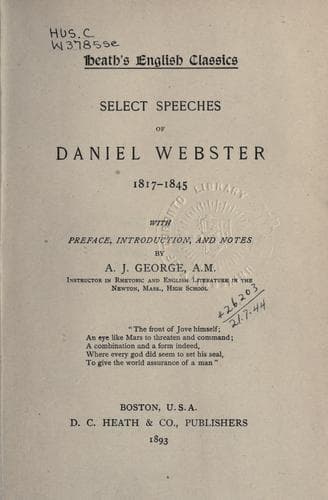
Select Speeches of Daniel Webster, 1817-1845Webster, Daniel
General
Select Speeches of Daniel Webster, 1817-1845
Webster, Daniel
Speeches, addresses, etc., American
Whoever argues against these principles argues against the
practicability of all free governments. And whoever admits these, must
admit, or cannot deny, that power is as safe in the hands of Congress
as in those of other representative bodies. Congress is not
irresponsible. Its members are agents of the people, elected by them,
answerable to them, and liable to be displaced or superseded, at their
pleasure; and they possess as fair a claim to the confidence of the
people, while they continue to deserve it, as any other public
political agents.
If, then, Sir, the manifest intention of the Convention, and the
contemporary admission of both friends and foes, prove anything; if the
plain text of the instrument itself, as well as the necessary
implication from other provisions, prove anything; if the early
legislation of Congress, the course of judicial decisions, acquiesced
in by all the States for forty years, prove any thing,--then it is
proved that there is a supreme law, and a final interpreter.
My fourth and last proposition, Mr. President, was, that any attempt by
a State to abrogate or nullify acts of Congress is a usurpation on the
powers of the general government and on the equal rights of other
States, a violation of the Constitution, and a proceeding essentially
revolutionary. This is undoubtedly true, if the preceding propositions
be regarded as proved. If the government of the United States be
trusted with the duty, in any department, of declaring the extent of
its own powers, then a State ordinance, or act of legislation,
authorizing resistance to an act of Congress, on the alleged ground of
its unconstitutionality, is manifestly a usurpation upon its powers. If
the States have equal rights in matters concerning the whole, then for
one State to set up her judgment against the judgment of the rest, and
to insist on executing that judgment by force, is also a manifest
usurpation on the rights of other States. If the Constitution of the
United States be a government proper, with authority to pass laws, and
to give them a uniform interpretation and execution, then the
interposition of a State, to enforce her own construction, and to
resist, as to herself, that law which binds the other States, is a
violation of the Constitution.
If that be revolutionary which arrests the legislative, executive, and
judicial power of government, dispenses with existing oaths and
obligations of obedience, and elevates another power to supreme
dominion, then nullification is revolutionary. Or if that be
revolutionary the natural tendency and practical effect of which are to
break the Union into fragments, to sever all connection among the
people of the respective States, and to prostrate this general
government in the dust, then nullification is revolutionary.
Public-domain text, read in full here on John Shaqi.
Reviews
Reviews
No reviews yet
Be the first to share your thoughts on this work.
Elsewhere in the archive
Join the Discussion
Join the discussion
Sign in to leave a comment or review.
Sign InorCreate an account