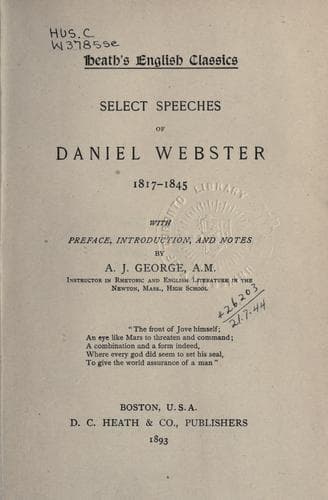
Select Speeches of Daniel Webster, 1817-1845Webster, Daniel
General
Select Speeches of Daniel Webster, 1817-1845
Webster, Daniel
Speeches, addresses, etc., American
Nullification, Sir, is as distinctly revolutionary as secession; but I
cannot say that the revolution which it seeks is one of so respectable
a character. Secession would, it is true, abandon the Constitution
altogether; but then it would profess to abandon it. Whatever other
inconsistencies it might run into, one, at least, it would avoid. It
would not belong to a government, while it rejected its authority. It
would not repel the burden, and continue to enjoy the benefits. It
would not aid in passing laws which others are to obey, and yet reject
their authority as to itself. It would not undertake to reconcile
obedience to public authority with an asserted right of command over
that same authority. It would not be in the government, and above the
government, at the same time. But though secession may be a more
respectable mode of attaining the object than nullification, it is not
more truly revolutionary. Each, and both, resist the constitutional
authorities; each, and both, would sever the Union and subvert the
government.
Mr. President, having detained the Senate so long already, I will not
now examine at length the ordinance and laws of South Carolina. These
papers are well drawn for their purpose. Their authors understood their
own objects. They are called a peaceable remedy, and we have been told
that South Carolina, after all, intends nothing but a lawsuit. A very
few words, Sir, will show the nature of this peaceable remedy, and of
the lawsuit which South Carolina contemplates.
In the first place, the ordinance declares the law of last July, and
all other laws of the United States laying duties, to be absolutely
null and void, and makes it unlawful for the constituted authorities of
the United States to enforce the payment of such duties. It is
therefore, Sir, an indictable offence, at this moment, in South
Carolina, for any person to be concerned in collecting revenue under
the laws of the United States. It being declared, by what is considered
a fundamental law of the State, unlawful to collect these duties, an
indictment lies, of course, against any one concerned in such
collection; and he is, on general principles, liable to be punished by
fine and imprisonment. The terms, it is true, are, that it is unlawful
"to enforce the payment of duties"; but every custom-house officer
enforces payment while he detains the goods in order to obtain such
payment. The ordinance, therefore, reaches everybody concerned in the
collection of the duties.
Public-domain text, read in full here on John Shaqi.
Reviews
Reviews
No reviews yet
Be the first to share your thoughts on this work.
Elsewhere in the archive
Join the Discussion
Join the discussion
Sign in to leave a comment or review.
Sign InorCreate an account