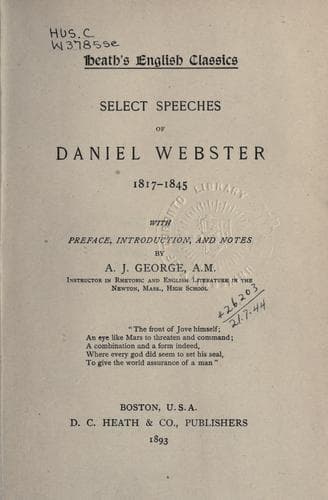
Select Speeches of Daniel Webster, 1817-1845Webster, Daniel
General
Select Speeches of Daniel Webster, 1817-1845
Webster, Daniel
Speeches, addresses, etc., American
This is the first step in the prosecution of the peaceable remedy. The
second is more decisive. By the act commonly called _replevin_ law, any
person whose goods are seized or detained by the collector for the
payment of duties may sue out a writ of replevin, and, by virtue of
that writ, the goods are to be restored to him. A writ of replevin is a
writ which the sheriff is bound to execute, and for the execution of
which he is bound to employ force, if necessary. He may call out the
_posse_, and must do so, if resistance be made. This _posse_ may be
armed or unarmed. It may come forth with military array, and under the
lead of military men. Whatever number of troops may be assembled in
Charleston, they may be summoned, with the governor, or
commander-in-chief, at their head, to come in aid of the sheriff. It is
evident, then, Sir, that the whole military power of the State is to be
employed, if necessary, in dispossessing the custom-house officers, and
in seizing and holding the goods, without paying the duties. This is
the second step in the peaceable remedy.
Sir, whatever pretences may be set up to the contrary, this is the
direct application of force, and of military force. It is unlawful, in
itself, to replevy goods in the custody of the collectors. But this
unlawful act is to be done, and it is to be done by force. Here is a
plain interposition, by physical force, to resist the laws of the
Union. The legal mode of collecting duties is to detain the goods till
such duties are paid or secured. But force comes, and overpowers the
collector and his assistants, and takes away the goods, leaving the
duties unpaid. There cannot be a clearer case of forcible resistance to
law. And it is provided that the goods thus seized shall be held
against any attempt to retake them, by the same force which seized them.
Having thus dispossessed the officers of the government of the goods,
without payment of duties, and seized and secured them by the strong
arm of the State, only one thing more remains to be done, and that is,
to cut off all possibility of legal redress; and that, too, is
accomplished, or thought to be accomplished. The ordinance declares,
_that all judicial proceedings founded on the revenue laws_ (including,
of course, proceedings in the courts of the United States), _shall be
null and void_. This nullifies the judicial power of the United States.
Then comes the test-oath act. This requires all State judges and jurors
in the State courts to swear that they will execute the ordinance, and
all acts of the legislature passed in pursuance thereof. The ordinance
declares, that no appeal shall be allowed from the decision of the
State courts to the Supreme Court of the United States; and the
replevin act makes it an indictable offence for any clerk to furnish a
copy of the record, for the purpose of such appeal.
Public-domain text, read in full here on John Shaqi.
Reviews
Reviews
No reviews yet
Be the first to share your thoughts on this work.
Elsewhere in the archive
Join the Discussion
Join the discussion
Sign in to leave a comment or review.
Sign InorCreate an account