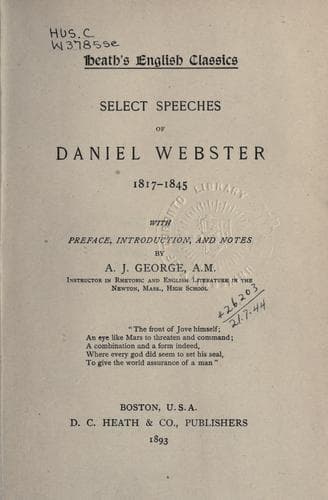
Select Speeches of Daniel Webster, 1817-1845Webster, Daniel
General
Select Speeches of Daniel Webster, 1817-1845
Webster, Daniel
Speeches, addresses, etc., American
to resist their execution by her own sovereign power; and she declares
that she will resist it, though such resistance should shatter the
Union into atoms.
Mr. President, I do not intend to discuss the propriety of these laws
at large; but I will ask, How are they shown to be thus plainly and
palpably unconstitutional? Have they no countenance at all in the
Constitution itself? Are they quite new in the history of the
government? Are they a sudden and violent usurpation on the rights of
the States? Sir, what will the civilized world say, what will posterity
say, when they learn that similar laws have existed from the very
foundation of the government, that for thirty years the power was never
questioned, and that no State in the Union has more freely and
unequivocally admitted it than South Carolina herself?
To lay and collect duties and imposts is an _express power_ granted by
the Constitution to Congress. It is, also, an _exclusive power_; for
the Constitution as expressly prohibits all the States from exercising
it themselves. This express and exclusive power is unlimited in the
terms of the grant, but is attended with two specific restrictions:
first, that all duties and imposts shall be equal in all the States;
second, that no duties shall be laid on exports. The power, then, being
granted, and being attended with these two restrictions, and no more,
who is to impose a third restriction on the general words of the grant?
If the power to lay duties, as known among all other nations, and as
known in all our history, and as it was perfectly understood when the
Constitution was adopted, includes a right of discriminating while
exercising the power, and of laying some duties heavier and some
lighter, for the sake of encouraging our own domestic products, what
authority is there for giving to the words used in the Constitution a
new, narrow, and unusual meaning? All the limitations which the
Constitution intended, it has expressed; and what it has left
unrestricted is as much a part of its will as the restraints which it
has imposed.
Public-domain text, read in full here on John Shaqi.
Reviews
Reviews
No reviews yet
Be the first to share your thoughts on this work.
Elsewhere in the archive
Join the Discussion
Join the discussion
Sign in to leave a comment or review.
Sign InorCreate an account