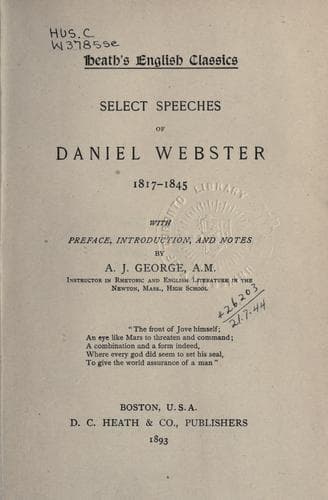
Select Speeches of Daniel Webster, 1817-1845Webster, Daniel
General
Select Speeches of Daniel Webster, 1817-1845
Webster, Daniel
Speeches, addresses, etc., American
But these laws, it is said, are unconstitutional on account of the
_motive_. How, Sir, can a law be examined on any such ground? How is
the motive to be ascertained? One house, or one member, may have one
motive; the other house, or another member, another. One motive may
operate to-day, and another to-morrow. Upon any such mode of reasoning
as this, one law might be unconstitutional now, and another law, in
exactly the same words, perfectly constitutional next year. Besides,
articles may not only be taxed for the purpose of protecting home
products, but other articles may be left free, for the same purpose and
with the same motive. A law, therefore, would become unconstitutional
from what it omitted, as well as from what it contained. Mr. President,
it is a settled principle, acknowledged in all legislative halls,
recognized before all tribunals, sanctioned by the general sense and
understanding of mankind, that there can be no inquiry into the motives
of those who pass laws, for the purpose of determining on their
validity. If the law be within the fair meaning of the words in the
grant of the power, its authority must be admitted until it is
repealed. This rule, everywhere acknowledged, everywhere admitted, is
so universal and so completely without exception, that even an
allegation of fraud, in the majority of a legislature, is not allowed
as a ground to set aside a law.
But, Sir, is it true that the motive for these laws is such as is
stated? I think not. The great object of all these laws is,
unquestionably, revenue. If there were no occasion for revenue, the
laws would not have been passed; and it is notorious that almost the
entire revenue of the country is derived from them. And as yet we have
collected none too much revenue. The treasury has not been more reduced
for many years than it is at the present moment. All that South
Carolina can say is, that, in passing the laws which she now undertakes
to nullify, _particular imparted articles were taxed, from a regard to
the protection of certain articles of domestic manufacture, higher than
they would have been had no such regard been entertained_. And she
insists, that, according to the Constitution, no such discrimination
can be allowed; that duties should be laid for revenue, and revenue
only; and that it is unlawful to have reference, in any case, to
protection. In other words, she denies the power of DISCRIMINATION. She
does not, and cannot, complain of excessive taxation; on the contrary,
she professes to be willing to pay any amount for revenue, merely as
revenue; and up to the present moment there is no surplus of revenue.
Her grievance, then, that plain and palpable violation of the
Constitution which she insists has taken place, is simply the exercise
of the power of DISCRIMINATION. Now, Sir, is the exercise of this power
of discrimination plainly and palpably unconstitutional?
Public-domain text, read in full here on John Shaqi.
Reviews
Reviews
No reviews yet
Be the first to share your thoughts on this work.
Elsewhere in the archive
Join the Discussion
Join the discussion
Sign in to leave a comment or review.
Sign InorCreate an account