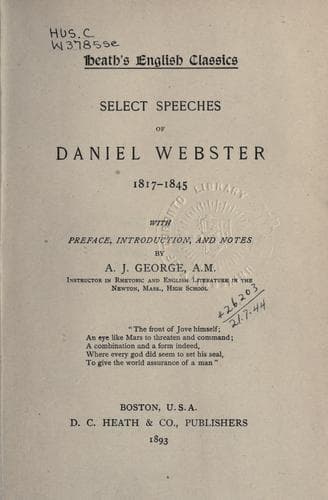
Select Speeches of Daniel Webster, 1817-1845Webster, Daniel
General
Select Speeches of Daniel Webster, 1817-1845
Webster, Daniel
Speeches, addresses, etc., American
Massachusetts bar. It is a model of close, simple, unadorned argument,
adapted to the minds of the jurymen. In it there are no attempts to
carry the jury off their feet by lofty appeals to their sense of
justice, nor to cover the weak points in the case by fine oratory. The
oft-repeated, "It is for the jury to determine," illustrates Mr.
Webster's respect for the common sense of the jurymen before him and
his reliance upon evidence to win the case. The following are the facts
relating to the case:--Major Goodridge of Bangor, Maine, professed to
have been robbed of a large sum of money at nine o'clock on the night
of Dec. 19, 1816, while travelling on horseback, near the bridge
between Exeter and Newburyport. In the encounter with the robbers he
received a pistol wound in his left hand; he was then dragged from his
horse into a field, beaten until insensible, and robbed. On recovering,
he procured the assistance of several persons, and with a lantern
returned to the place of the robbery and found his watch and some
papers. The next day he went to Newburyport, and remained ill for
several weeks, suffering from delirium caused by the shock. When he
recovered he set about the discovery of the robbers. His story seemed
so probable that he had the sympathy of all the country-folk. He at
once charged with the crime Levi and Laban Kenniston, two poor men, who
lived in an obscure part of the town of Newmarket, New Hampshire, and
finding some of his money (which he had previously marked) in their
cellar, he had them arrested, and held for trial. By and by a few of
the people began to doubt the story of Goodridge; this led him to
renewed efforts, and he arrested the toll gatherer, Mr. Pearson, in
whose house, by the aid of a conjurer, he found some of his money. On
examination by the magistrate, Pearson was discharged. It now became
necessary to find some accomplice of the Kennistons, and he arrested
one Taber of Boston, whom he had seen (he said) on his way up, and from
whom he had obtained his information against the Kennistons. In Taber's
house was found some of the money; he was accordingly bound over for
trial with the Kennistons. As none of these men lived near the scene of
the robbery, Mr. Jackman, who, soon after the robbery, had gone to New
York, was arrested, his house searched, and some of the money found in
the garret. The guilt of these men seemed so conclusive that no eminent
member of the Essex bar would undertake their defence. A few of those
who mistrusted Goodridge determined to send to Suffolk County for
counsel.
Public-domain text, read in full here on John Shaqi.
Reviews
Reviews
No reviews yet
Be the first to share your thoughts on this work.
Elsewhere in the archive
Join the Discussion
Join the discussion
Sign in to leave a comment or review.
Sign InorCreate an account