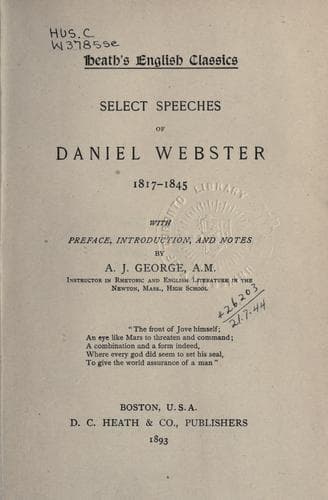
Select Speeches of Daniel Webster, 1817-1845Webster, Daniel
General
Select Speeches of Daniel Webster, 1817-1845
Webster, Daniel
Speeches, addresses, etc., American
Mr. Webster had been well known in New Hampshire, and his services were
at once secured; without having time to examine any of the details of
the case--as he had arrived at Ipswich on the night before the
trial--he at once undertook the defence of the Kennistons and secured
their acquittal. The indictment against Taber was _nol prossed_. Later,
he defended Jackman and secured his acquittal. Mr. Pearson brought
action against Goodridge for malicious prosecution, and was awarded
$2000, but Goodridge took the poor debtor's oath and left the State.
Cf. Curtis's _Life of Webster_, Ch. VIII.; Everett's _Memoir of
Webster_, in Vol. I. of Webster's Works.
* * * * *
_THE DARTMOUTH COLLEGE CASE_.
March, 1818.
Within a year after the defence of the Kennistons, Mr. Webster was
called upon to defend his Alma Mater against the acts of the
Legislature of his native State.
The case was one of the most interesting ever argued before the Supreme
Court of the United States, because there were involved in it certain
constitutional questions which had never been tested. "Mr. Webster by
his management of this case," says Edward Everett, "took the lead in
establishing what might almost be called a new school of constitutional
law." Not until within a few years has the complete history of the case
been accessible. In 1879, a volume of "Dartmouth College Causes" was
published by Mr. John M. Shirley, and in it we have, for the first
time, a clear statement of all the points relating to the origin and
development of the case.
Dartmouth College was originally a charity school, and was founded by
Eleazor Wheelock at Lebanon, Connecticut, in 1754. Afterwards private
subscriptions were solicited in England, and the Earl of Dartmouth was
a large donor and became one of the trustees. The site was soon moved
to Hanover, New Hampshire, where large grants of land had been made by
the proprietors. It was chartered by the Crown in 1769, and was created
a perpetual corporation, with Dr. Wheelock as founder and President; he
was empowered to name his own successor subject to the approval of the
trustees, to whom was given power to fill vacancies in their own body
and to make laws for the College subject to the Crown.
Public-domain text, read in full here on John Shaqi.
Reviews
Reviews
No reviews yet
Be the first to share your thoughts on this work.
Elsewhere in the archive
Join the Discussion
Join the discussion
Sign in to leave a comment or review.
Sign InorCreate an account