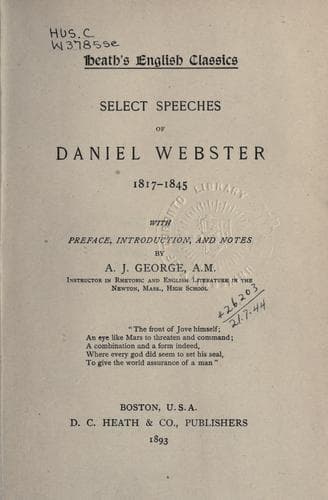
Select Speeches of Daniel Webster, 1817-1845Webster, Daniel
General
Select Speeches of Daniel Webster, 1817-1845
Webster, Daniel
Speeches, addresses, etc., American
[2]P. 59, l. 5. 1. I give the beautiful description which Dr. Goodrich
wrote to Mr. Choate in 1853. "Here the feelings, which he had thus far
succeeded in keeping down, broke forth. His lips quivered; his firm
cheeks trembled with emotion; his eyes were filled with tears; his
voice choked, and he seemed struggling to the utmost simply to gain
that mastery over himself which might save him from an unmanly burst of
feeling. I will not attempt to give you the few broken words of
tenderness in which he went on to speak of his attachment for the
college. The whole seemed to be mingled throughout with recollections
of father, mother, brother, and all the privations and trials through
which he had made his way into life. Every one saw that it was wholly
unpremeditated, a pressure on his heart, which sought relief in words
and tears." The court-room during these two or three minutes presented
an extraordinary spectacle. Chief Justice Marshall, with his tall and
gaunt figure, bent over as if to catch the slightest whisper, the deep
furrows of his cheek expanded with emotion, and his eyes suffused with
tears; Mr. Justice Washington at his side, with his small and emaciated
frame, and countenance more like marble than I ever saw on any other
human being--leaning forward with an eager troubled look; and the
remainder of the Court at the two extremities, pressing, as it were,
toward a single point, while the audience below were wrapping
themselves around in closer folds beneath the bench, to catch each look
and every feature of the speaker's face. If a painter could give us the
scene on canvas,--those forms and countenances, and Daniel Webster as
he there stood in their midst,--it would be one of the most touching
pictures in the history of eloquence. One thing it taught me, that the
_pathetic_ depends not merely on the words uttered, but still more on
the estimate we put upon him who utters them. There was not one among
the strong-minded men of that assembly who could think it unmanly to
weep, when he saw standing before him the man who had made such an
argument, melted into the tenderness of a child. Mr. Webster had now
recovered his composure, and, fixing his keen eye on the Chief Justice,
in that deep tone with which he sometimes thrilled the heart of an
audience, continued."[3] L. 10. 2. When Mr. Webster sat down, there was
a stillness as of death in the court-room, and when the audience had
slowly recovered itself the replies of the opposing counsel were made,
but seemed weak indeed in comparison to what had just been heard. On
the conclusion of the arguments, the Chief Justice announced that the
Court could not agree, and that the case must be continued to the next
term. During the interim, the utmost effort was used by the friends of
the College, the press, and the Federalists, to bring the matter before
the public, and to impress the judges with the condition of the public
mind. The defence prepared to renew the contest, and able counsel was
Public-domain text, read in full here on John Shaqi.
Reviews
Reviews
No reviews yet
Be the first to share your thoughts on this work.
Elsewhere in the archive
Join the Discussion
Join the discussion
Sign in to leave a comment or review.
Sign InorCreate an account