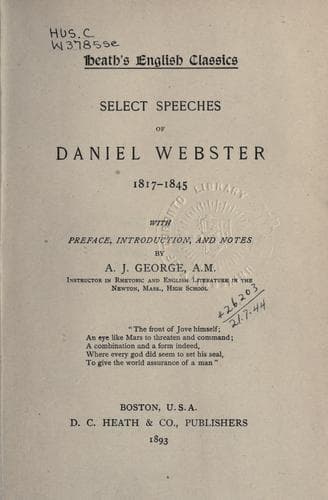
Select Speeches of Daniel Webster, 1817-1845Webster, Daniel
General
Select Speeches of Daniel Webster, 1817-1845
Webster, Daniel
Speeches, addresses, etc., American
In Mr. Mason's brief we find that there were three points made against
the Acts of the Legislature: (1) that they were not within the power of
that body; (2) that they violated the Constitution of New Hampshire;
and (3) that they violated the Constitution of the United States, or
the right of private contracts. The third point was not, however,
pressed by the counsel, and was not considered as very important; they
based their case mostly upon the first point: that the College was
founded by private parties, for special purposes, and that any quarrel
of the trustees was a question for the courts to settle, and not for
the Legislature. When it was decided against them, they removed the
case to the Supreme Court of the United States on this one point, that
the acts impaired the obligation of contracts. The friends of the
College now desired Mr. Webster to take entire charge of the case; he
consented, and selected as his assistant, Mr. Hopkinson, of
Philadelphia. Mr. Holmes of Maine and Mr. Wirt conducted the defence.
The case was heard on March 10, 1818, and was opened by Mr. Webster.
With the notes and minutes of the previous counsel Mr. Webster was
familiar, and he said that the credit of the legal points and theories
he set forth was due to them; he was only the arranger and reciter of
what they had prepared. Mr. Webster had a remarkable power of selecting
and using the material of other men, but he was always ready to give
them the credit due.
With a skill and judgment which Chief Justice Marshall said he never
saw equalled, Mr. Webster outlined the question at issue, and by his
marvellous adroitness in arranging, and clearness in presenting the
facts, together with that wealth of legal and historical illustration
with which he was always so well endowed, he seemed to carry with him
every man in the court-room. Such was the ease, grace, and fascination
of his argument, that Justice Story, who sat, pen in hand, to take
notes, was completely absorbed and forgot his pen and paper.
[1]P. 58, l. 15. I. Here, the argument being ended, Mr. Webster stood
still for some time before the court, while every eye was fixed upon
him, and then addressing the Chief Justice, he proceeded with that
noble peroration which has become one of the masterpieces of eloquence,
and which is an expansion of the closing argument which he delivered at
the previous trial in New Hampshire. This does not appear in the
printed argument; I have added it from the report of Dr. Goodrich.
Public-domain text, read in full here on John Shaqi.
Reviews
Reviews
No reviews yet
Be the first to share your thoughts on this work.
Elsewhere in the archive
Join the Discussion
Join the discussion
Sign in to leave a comment or review.
Sign InorCreate an account