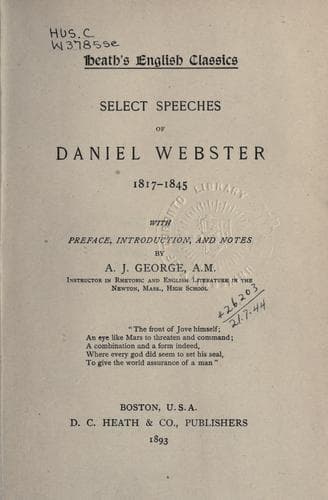
Select Speeches of Daniel Webster, 1817-1845Webster, Daniel
General
Select Speeches of Daniel Webster, 1817-1845
Webster, Daniel
Speeches, addresses, etc., American
On the 29th of December, 1829, Senator Foot of Connecticut moved a
resolution in regard to the Public Lands, and a long and weary
discussion followed until Mr. Hayne, a Senator from South Carolina, on
June 19, 1830, took part and introduced a new element into the
discussion by making an elaborate attack on the New England States. Mr.
Webster had taken no special interest in the question, and on the day
in which Mr. Hayne began his speech he was engaged in the Supreme
Court, but came into the Senate in season to hear the closing
paragraphs. Thinking that such an attack upon New England required a
reply, Mr. Webster at once rose, but yielded to a motion to adjourn. On
the next day, the 20th, Mr. Webster proceeded with his reply, in which
he showed the absurdity of Hayne's accusations and by which he
completely shattered his whole elaborate argument. There was hardly an
allusion in Mr. Webster's speech to the question of the tariff as it
concerned South Carolina, but so aroused was Hayne by Webster's defence
of New England, that on the following day he spoke a second time and in
a tone of even greater severity and bitterness than that which marked
his previous speech; he indulged in personal allusion to Mr. Webster,
and strove to bring odium upon him and the State which he represented;
he openly espoused the cause of Nullification and declared war upon the
tariff. Before he concluded the Senate adjourned until the 25th, when
he completed his speech; Mr. Webster immediately rose to reply, but as
it was late yielded to a motion to adjourn. Mr. Hayne's speech had
caused the greatest alarm throughout the North; many were afraid that
it was unanswerable. This was an evidence that the true nature of the
Constitution was not thoroughly understood. "It is a critical moment,"
said Mr. Bell of New Hampshire to Mr. Webster on the morning of the
26th, "and it is time, it is high time, that the people of this country
should know what this Constitution _is_." "Then," said Mr. Webster, "by
the blessing of Heaven, they shall learn, this day, before the sun goes
down, what I understand it to be." With this utterance upon his lips,
he entered the Senate Chamber, which was already crowded. Every seat on
the floor and in the galleries was occupied; the House of
Representatives was deserted; the lobbies and staircases were packed.
The vast audience was composed, on the one hand, of those who feared
and trembled lest the rushing tide of hostility to the Constitution and
the Union should sweep over the country; and on the other, of those who
believed that New England had no champion strong enough to stand in the
breach. This scene in the Senate Chamber is rivalled only by that in
the House of Commons, when Burke, in 1774, stood forth as the defender
of the American colonies. Such was the anxiety to hear the speech that
all the ordinary preliminaries of senatorial action were postponed, and
Mr. Webster began his "Second Speech on Foot's Resolution," better
Public-domain text, read in full here on John Shaqi.
Reviews
Reviews
No reviews yet
Be the first to share your thoughts on this work.
Elsewhere in the archive
Join the Discussion
Join the discussion
Sign in to leave a comment or review.
Sign InorCreate an account