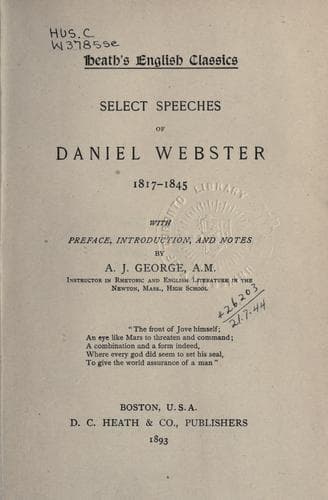
Select Speeches of Daniel Webster, 1817-1845Webster, Daniel
General
Select Speeches of Daniel Webster, 1817-1845
Webster, Daniel
Speeches, addresses, etc., American
known as "The Reply to Hayne."
[1]P. 146, l. 10. 1. Mr. Webster rose with great calmness, and in the
majesty of that personal presence which could cause the English navvy
to shout as he saw him, "By Jove, there goes a king!" with a confidence
in his own resources which was the result of experience, in a clear,
calm, and firm tone pronounced this magnificent exordium which was such
a piece of consummate art that its effect was electric; all who feared,
and all who hated, knew that he was master of the situation.
[ 2] P. 147, l. 27. 1. When on the 21st Mr. Chambers asked that there
be a delay to enable Mr. Webster, who had engagements out of the house,
to be present, Mr. Hayne was unwilling to grant the request, saying
that the gentleman (Mr. Webster) has discharged his fire in the
presence of the Senate, and he wanted an opportunity to return it. Mr.
Webster said, "Let the discussion proceed: I am ready now to receive
the gentleman's fire."
[3] P. 149, l. 8. 1. The notes, covering only five sheets of ordinary
letter paper, from which Webster developed the entire speech of seventy
pages, contain no hint of the exordium, but begin with
"No man hurt. If his 'rankling' is relieved, glad of it."
"I have no 'rankling' fear, anger, consciousness of refutation."
"No 'rankling,' original, or received--bow not strong enough."
[4]L. 12. 2. Mr. Benton.
[5]L. 27. 3. Mr. Webster's preparation for this reply lay in the nature
of his thought and reading from his first entrance into public life,
and especially from the nature of the constitutional questions which he
has argued before the Supreme Court of the United States.
[6]P. 152, l. 1. 1. Should not this be "_more_"?
[7]L. 24. 2. This was a political cry raised against President Adams,
who was elected by the House of Representatives. Clay had been a
candidate, and because Adams gave him a seat in his Cabinet, a cry went
up that they had made a bargain, by which Mr. Clay's friends were to
vote for Adams in the House, and in return Clay was to receive a
Cabinet position. This was a piece of political clap-trap. Cf.
_American Politics_, Johnston, Ch. XI.
[8]P. 155, l. 5. 1. If there had been a coalition and it was killed, it
was killed by Calhoun, who threw all his influence against Adams and
for Jackson. But at the time of this speech Calhoun was treated
somewhat cavalierly by Jackson, and had not much reward in party
succession.
[9]P. 157, l. 13. 1. "The Missouri Compromise." Cf. _American
Politics_, Johnston, Ch. VIII.
[10]P. 162, l. 22. 1. This Convention of 1814 was composed of men of
the old Federal party, strongly opposed to war with Great Britain. Cf.
_American Politics_, Johnston, Ch. VIII.
[11]P. 170, l. 3. 1. The "South Carolina Canal & Railroad Company" had
on Jan. 9, 1830, asked Mr. Webster to present its claims to government
assistance.
[12]P. 179, l. 5. 1. Calhoun, Vice-President, and President of Senate.
[13]P. 180, l. 5. 1. Mr. Forsyth.
Public-domain text, read in full here on John Shaqi.
Reviews
Reviews
No reviews yet
Be the first to share your thoughts on this work.
Elsewhere in the archive
Join the Discussion
Join the discussion
Sign in to leave a comment or review.
Sign InorCreate an account