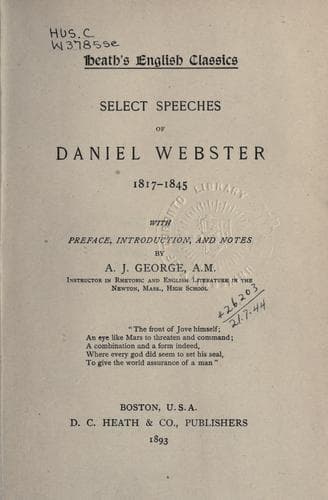
Select Speeches of Daniel Webster, 1817-1845Webster, Daniel
General
Select Speeches of Daniel Webster, 1817-1845
Webster, Daniel
Speeches, addresses, etc., American
At a special term of the Supreme Court at Salem, July 20th, indictments
for murder were found against Francis Knapp as principal, and Joseph
Knapp and George Crowningshield (a companion of Richard) as
accessories. The trial of Francis took place August 3d, with Mr.
Franklin Dexter and Mr. W. H. Gardner for the defence, and Mr. Webster
assisting the Attorney-General in the prosecution.
[1]P. 239, l. 13. 1. Mr. Lodge says that this account of the murder and
analysis of the workings of a mind, haunted with the remembrance of the
horrid crime, must be placed among the very finest masterpieces of
modern oratory. "I have studied this famous exordium," he says, "with
extreme care, and I have sought diligently in the works of all the
great modern orators, and of some of the ancient as well, for similar
passages of higher merit. My quest has been in vain."
[2]P. 241, l. 23. 1. Mr. Webster's appearance for the prosecution gave
rise to some complaints on the part of the defence, who intimated that
he was in the interest of Mr. Stephen White, a residuary legatee of the
murdered man. The fact was that both the Attorney-General and the
Solicitor-General were old men, and had asked for Mr. Webster's
assistance.
[3]P. 243, l. 20. 1. Chief Justice Parker.
[4]P. 248, l. 10. 1. Mr. Webster's presentation of the evidence is
omitted. Cf. Webster's Complete Works, Vol. VI., p. 61.
Knapp was convicted as principal and sentenced to death. At the
November term Joseph was convicted as accessory and sentenced to share
the same fate. George Crowningshield proved an _alibi_, and was
acquitted. The argument in the Goodridge case stands in marked contrast
to this; and it must be conceded that, as a presentation of the law and
the evidence, with no attempt to work upon the feelings of the jurymen,
it is a work of higher quality. As a specimen of eloquence, of dramatic
setting forth of the horror of such a deed, of the experiences of the
criminal, and of the certainty that "murder will out," the argument has
no equal in the language.
For a remarkable analysis of Mr. Webster's career as a lawyer, see
Rufus Choate's address before the students of Dartmouth College in 1853
in "Memorial of Daniel Webster from the City of Boston."
* * * * *
_THE CONSTITUTION NOT A COMPACT_.
February, 1833.
Public-domain text, read in full here on John Shaqi.
Reviews
Reviews
No reviews yet
Be the first to share your thoughts on this work.
Elsewhere in the archive
Join the Discussion
Join the discussion
Sign in to leave a comment or review.
Sign InorCreate an account