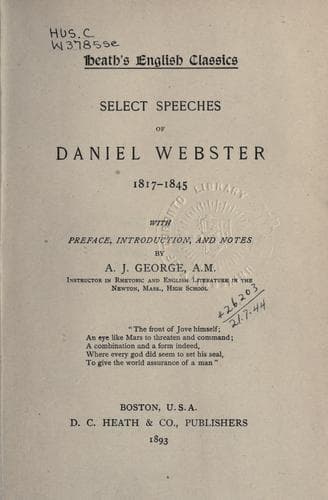
Select Speeches of Daniel Webster, 1817-1845Webster, Daniel
General
Select Speeches of Daniel Webster, 1817-1845
Webster, Daniel
Speeches, addresses, etc., American
Mr. Webster had intimated in his Reply to Hayne that South Carolina was
playing a high game. There were some at that time who thought that he
had sounded the note of alarm in too loud a strain; but when in
November, 1832, the State Convention, assembled at Columbia, South
Carolina, adopted an ordinance declaring the revenue laws of the United
States null and void, the voice of the croakers ceased to be heard in
the general excitement that filled the country. The Legislature
assembled on the 27th, and the governor in his message said that "the
die has been at last cast," and that the Legislature was called upon to
make "such enactments as would make it utterly impossible to collect
within our limits the duties imposed by the protective tariffs thus
nullified." The Legislature passed acts providing that any one who
should attempt to collect the revenue should be punished, and made it
lawful to use the military force of the State to resist any attempt of
the United States to enforce the tariff laws. Mr. Webster now had a
very difficult and delicate task before him; he was bound to criticise
the general tone of the administration of Jackson, for he believed that
it had not met the needs of the country, and yet he was equally bound
not to put himself in such antagonism as to prevent him from aiding the
administration, should his aid be sought, against those who were
determined to destroy the laws of the land. In the then impending
presidental canvass he took the ground that President Jackson was in
hostility to the idea of protection, and that therefore he could not be
safely trusted with the executive power. But President Jackson,
whatever had been his record on the question of the tariff, showed that
he had no desire to shirk his duty, for he at once issued a
proclamation, which embodied the principles maintained by Mr. Webster
in his Reply to Hayne, and warned the authorities of South Carolina
that all opposition to the laws of the United States would be put down.
He thus served notice that treason was not to win by default of the
President. Calhoun had resigned the vice-presidency and had taken his
seat in the Senate, and it was known that such an act meant the attempt
to raise the flag of nullification high in the Senate-chamber.
Public-domain text, read in full here on John Shaqi.
Reviews
Reviews
No reviews yet
Be the first to share your thoughts on this work.
Elsewhere in the archive
Join the Discussion
Join the discussion
Sign in to leave a comment or review.
Sign InorCreate an account