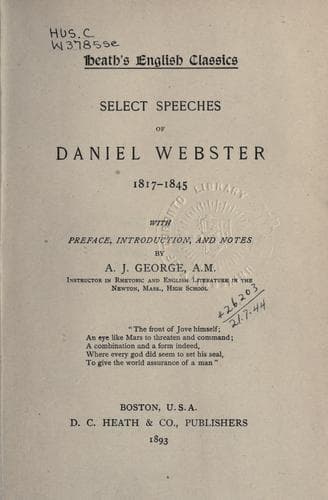
Select Speeches of Daniel Webster, 1817-1845Webster, Daniel
General
Select Speeches of Daniel Webster, 1817-1845
Webster, Daniel
Speeches, addresses, etc., American
Mr. Webster was on his way to Washington when he heard of the prompt
and decisive action of the President. At Philadelphia he met Mr. Clay,
who told him that he had a plan for settling the difficulty by
gradually reducing the tariff, and for levying duties "without regard
to protection or encouragement of any branch of domestic industry."
When Mr. Clay brought in his bill, it was not so strong as the one he
had submitted to Mr. Webster a short time before, but yet Mr. Webster
could not think of taking any step at such a time that would look like
concession. The first thing to be done was to enforce the existing laws
and sustain the administration by suitable legislation. There was to be
no surrender of constitutional power. At the opening of the session the
President asked Congress for the power to use the land and naval forces
if necessary to enforce the laws. The committee to which the message
was referred reported what is known as the "Force Bill," which granted
the President the powers asked for. Some of the senators doubted that
the President had such "daring effrontery" as to ask for such power.
Mr. Webster said, "I will tell you gentlemen that the President _has_
had the 'daring effrontery' to ask for these powers, no matter how high
may be the offence."
President Jackson had used very strong language against the leaders of
Nullification, and this made many of the (Southern) administration
senators hostile to the measures of the "Force Bill." When it was found
that the President had called for the assistance of Mr. Webster, Mr.
Calhoun became very uneasy, and at once sought for Mr. Clay, who
promised to bring in his bill for reducing the tariff. On the 8th of
February, Mr. Clay introduced the measure and claimed that its purpose
was to save the tariff, which he considered to be in imminent danger.
Mr. Webster, as was expected, opposed the bill and introduced a series
of resolutions. On the two following days he was prevented from
addressing the Senate on his resolutions because of the discussion of
the "Force Bill," when Mr. Calhoun took the opportunity to expound the
theory and practice of Nullification. The speech was in Mr. Calhoun's
very best style of close, logical argument, with but little that made
for eloquence. Calhoun was a master of logical method, and such was his
skill in dovetailing together the elements of his speculations that he
was a powerful antagonist. He had waited until most of the senators in
opposition had spoken and then broke upon them and tore their arguments
into shreds. It was an able supplement to the speech of Hayne and was
likely to produce quite as much alarm, unless its position could be
turned. Here were sown the seeds of secession which grew into that
frightful civil war. By establishing the principle of the Union as but
a confederacy of States the right of secession was assured.
Public-domain text, read in full here on John Shaqi.
Reviews
Reviews
No reviews yet
Be the first to share your thoughts on this work.
Elsewhere in the archive
Join the Discussion
Join the discussion
Sign in to leave a comment or review.
Sign InorCreate an account