Selections from Previous Works: With Remarks on Romanes' Mental Evolution in Animals, and a Psalm of MontrealButler, Samuel
Philosophy
Selections from Previous Works: With Remarks on Romanes' Mental Evolution in Animals, and a Psalm of Montreal
Butler, Samuel
English literature -- 19th century -- Miscellanea; Romanes, George John, 1848-1894. Mental evolution in animals
Transcribed from the 1884 Trubner & Co. edition by David Price, email
ccx074@pglaf.org
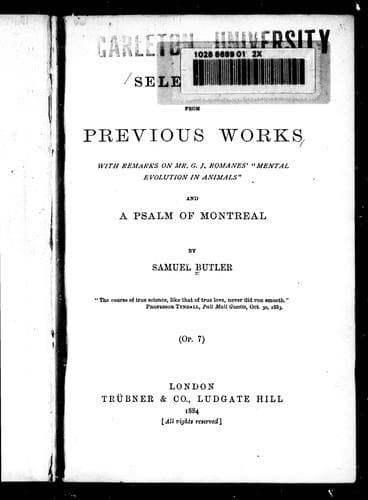
SELECTIONS FROM PREVIOUS WORKS
_WITH REMARKS ON MR. G. J. ROMANES'_ "_MENTAL EVOLUTION IN ANIMALS_"
AND
A PSALM OF MONTREAL
BY
SAMUEL BUTLER
"The course of true science, like that of true love, never did run
smooth."
PROFESSOR TYNDALL, _Pall Mall Gazette_, Oct 30, 1883.
(OP. 7)
LONDON
TRUBNER & CO., LUDGATE HILL
1884
[_All rights reserved_]
Ballantyne Press
BALLANTYNE, HANSON AND CO.
EDINBURGH AND LONDON
PREFACE.
I delayed these pages some weeks in order to give Mr. Romanes an
opportunity of explaining his statement that Canon Kingsley wrote about
instinct and inherited memory in _Nature_, Jan. 18, 1867. {iii} I wrote
to the _Athenaeum_ (Jan. 26, 1884) and pointed out that _Nature_ did not
begin to appear till nearly three years after the date given by Mr.
Romanes, and that there was nothing from Canon Kingsley on the subject of
instinct and inherited memory in any number of _Nature_ up to the date of
Canon Kingsley's death. I also asked for the correct reference.
This Mr. Romanes has not thought it incumbent upon him to give. I am
told I ought not to have expected him to give it, inasmuch as it is no
longer usual for men of any but the lowest scientific standing to correct
their misstatements when they are brought to book. Science is made for
Fellows of the Royal Society, and for no one else, not Fellows of the
Royal Society for science; and if the having achieved a certain position
should still involve being obliged to be as scrupulous and accurate as
other people, what is the good of the position? This view of the matter
is practical, but I regret that Mr. Romanes should have taken it, for his
having done so has prevented my being able to tell the reader what Canon
Kingsley said about memory and instinct, and this he might have been glad
to know.
I suspect, however, that what Canon Kingsley said was after all not very
important. If it had been, Mr. Romanes would have probably told us what
it was in his own book. I should think it possible that Mr. Romanes--not
finding Canon Kingsley's words important enough to be quoted, or even
referred to correctly, or never having seen them himself and not knowing
exactly what they were, yet being anxious to give every one, and more
particularly Canon Kingsley, his due--felt that this was an occasion on
which he might fairly take advantage of his position and say at large
whatever he was in the humour for saying at the moment.
Public-domain text, read in full here on John Shaqi.
Reviews
Reviews
No reviews yet
Be the first to share your thoughts on this work.
Join the Discussion
Join the discussion
Sign in to leave a comment or review.
Sign InorCreate an account