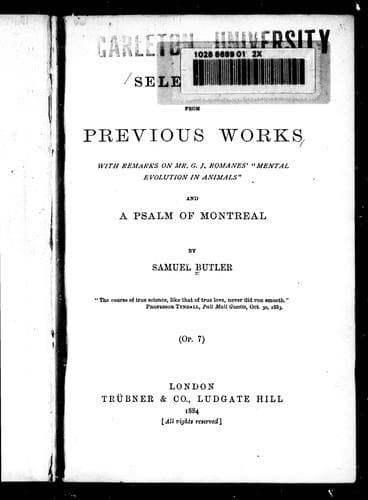
Selections from Previous Works: With Remarks on Romanes' Mental Evolution in Animals, and a Psalm of MontrealButler, Samuel
Philosophy
Selections from Previous Works: With Remarks on Romanes' Mental Evolution in Animals, and a Psalm of Montreal
Butler, Samuel
English literature -- 19th century -- Miscellanea; Romanes, George John, 1848-1894. Mental evolution in animals
Many of his epigrammatic sayings have passed into proverbs: for example,
that "genius is but a supreme capacity for taking pains." Another and
still more celebrated passage shall be given in its entirety and with its
original setting.
"Style," says Buffon, "is the only passport to posterity. It is not
range of information, nor mastery of some little known branch of science,
nor yet novelty of matter that will ensure immortality. Works that can
claim all this will yet die if they are conversant about trivial objects
only, or written without taste, genius, and true nobility of mind; for
range of information, knowledge of details, novelty of discovery are of a
volatile essence and fly off readily into other hands that know better
how to treat them. The matter is foreign to the man, and is not of him;
the manner is the man himself." {162}
"Le style, c'est l'homme memo." Elsewhere he tells us what true style
is, but I quote from memory and cannot be sure of the passage. "Le
style," he says "est comme le bonheur; il vient de la douceur de l'ame."
Is it possible not to think of the following?--
"But whether there be prophecies they shall fail; whether there be
tongues they shall cease; whether there be knowledge it shall vanish away
. . . and now abideth faith, hope and charity, these three; but the
greatest of these is charity." {163}
BUFFON'S METHOD--THE IRONICAL CHARACTER OF HIS WORK. (CHAPTER IX. OF
EVOLUTION, OLD AND NEW.)
Buffon's idea of a method amounts almost to the denial of the possibility
of method at all. "The true method," he writes, "is the complete
description and exact history of each particular object," {164a} and
later on he asks, "is it not more simple, more natural and more true to
call an ass an ass, and a cat a cat, than to say, without knowing why,
that an ass is a horse, and a cat a lynx?" {164b}
He admits such divisions as between animals and vegetables, or between
vegetables and minerals, but that done, he rejects all others that can be
founded on the nature of things themselves. He concludes that one who
could see living forms as a whole and without preconceived opinions,
would classify animals according to the relations in which he found
himself standing towards them:--
Public-domain text, read in full here on John Shaqi.
Reviews
Reviews
No reviews yet
Be the first to share your thoughts on this work.
Elsewhere in the archive
Join the Discussion
Join the discussion
Sign in to leave a comment or review.
Sign InorCreate an account