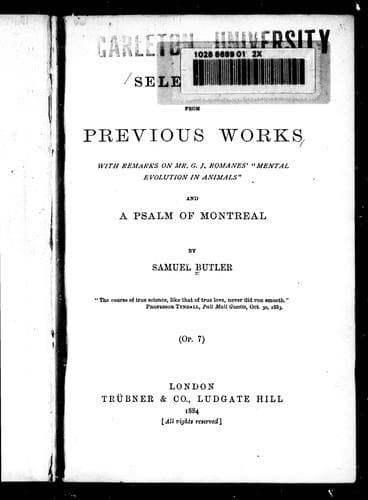
Selections from Previous Works: With Remarks on Romanes' Mental Evolution in Animals, and a Psalm of MontrealButler, Samuel
Philosophy
Selections from Previous Works: With Remarks on Romanes' Mental Evolution in Animals, and a Psalm of Montreal
Butler, Samuel
English literature -- 19th century -- Miscellanea; Romanes, George John, 1848-1894. Mental evolution in animals
"Those which he finds most necessary and useful to him will occupy the
first rank; thus he will give the precedence among the lower animals
to the dog and the horse; he will next concern himself with those
which without being domesticated, nevertheless occupy the same country
and climate as himself, as for example stags, hares, and all wild
animals; nor will it be till after he has familiarised himself with
all these that curiosity will lead him to inquire what inhabitants
there may be in foreign climates, such as elephants, dromedaries, &c.
The same will hold good for fishes, birds, insects, shells, and for
all nature's other productions; he will study them in proportion to
the profit which he can draw from them; he will consider them in that
order in which they enter into his daily life; he will arrange them in
his head according to this order, which is in fact that in which he
has become acquainted with them, and in which it concerns him to think
about them, This order--the most natural of all--is the one which I
have thought it well to follow in this volume. My classification has
no more mystery in it than the reader has just seen . . . it is
preferable to the most profound and ingenious that can be conceived,
for there is none of all the classifications which ever have been made
or ever can be, which has not more of an arbitrary character than this
has. Take it for all in all," he concludes, "it is more easy, more
agreeable, and more useful, to consider things in their relation to
ourselves than from any other standpoint." {165}
"Has it not a better effect not only in a treatise on natural history,
but in a picture or any work of art to arrange objects in the order
and place in which they are commonly found, than to force them into
association in virtue of some theory of our own? Is it not better to
let the dog which has toes, come after the horse which has a single
hoof, in the same way as we see him follow the horse in daily life,
than to follow up the horse by the zebra, an animal which is little
known to us, and which has no other connection with the horse than the
fact that it has a single hoof?" {166a}
Can we suppose that Buffon really saw no more connection than this? The
writer whom we shall presently find {166b} declining to admit any
essential difference between the skeletons of man and of the horse, can
here see no resemblance between the zebra and the horse, except that they
each have a single hoof. Is he to be taken at his word?
Public-domain text, read in full here on John Shaqi.
Reviews
Reviews
No reviews yet
Be the first to share your thoughts on this work.
Elsewhere in the archive
Join the Discussion
Join the discussion
Sign in to leave a comment or review.
Sign InorCreate an account