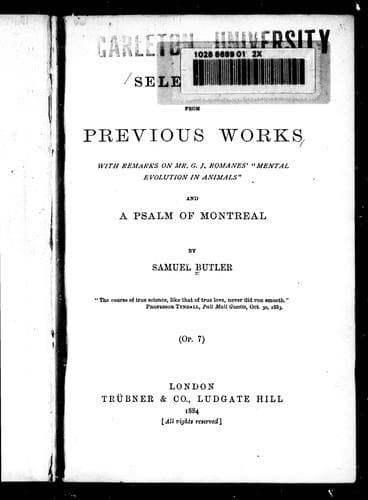
Selections from Previous Works: With Remarks on Romanes' Mental Evolution in Animals, and a Psalm of MontrealButler, Samuel
Philosophy
Selections from Previous Works: With Remarks on Romanes' Mental Evolution in Animals, and a Psalm of Montreal
Butler, Samuel
English literature -- 19th century -- Miscellanea; Romanes, George John, 1848-1894. Mental evolution in animals
"In the private character of Buffon," says Sir William Jardine in a
characteristic passage, "we regret there is not much to praise; his
disposition was kind and benevolent, and he was generally beloved by his
inferiors, followers, and dependants, which were numerous over his
extensive property; he was strictly honourable, and was an affectionate
parent. In early youth he had entered into the pleasures and
dissipations of life, and licentious habits seem to have been retained to
the end. But the great blemish in such a mind was his declared
infidelity; it presents one of those exceptions among the persons who
have been devoted to the study of nature; and it is not easy to imagine a
mind apparently with such powers, scarcely acknowledging a Creator, and
when noticed, only by an arraignment for what appeared wanting or
defective in His great works. So openly, indeed, was the freedom of his
religious opinions expressed, that the indignation of the Sorbonne was
provoked. He had to enter into an explanation which he in some way
rendered satisfactory; and while he afterwards attended to the outward
ordinances of religion, he considered them as a system of faith for the
multitude, and regarded those most impolitic who most opposed them."
{168}
This is partly correct and partly not. Buffon was a free-thinker, and as
I have sufficiently explained, a decided opponent of the doctrine that
rudimentary and therefore useless organs were designed by a Creator in
order to serve some useful end throughout all time to the creature in
which they are found.
He was not, surely, to hide the magnificent conceptions which he had been
the first to grasp, from those who were worthy to receive them; on the
other hand he would not tell the uninstructed what they would interpret
as a licence to do whatever they pleased, inasmuch as there was no God.
What he did was to point so irresistibly in the right direction, that a
reader of any intelligence should be in no doubt as to the road he ought
to take, and then to contradict himself so flatly as to reassure those
who would be shocked by a truth for which they were not yet ready. If I
am right in the view which I have taken of Buffon's work, it is not easy
to see how he could have formed a finer scheme, nor have carried it out
more finely.
Public-domain text, read in full here on John Shaqi.
Reviews
Reviews
No reviews yet
Be the first to share your thoughts on this work.
Elsewhere in the archive
Join the Discussion
Join the discussion
Sign in to leave a comment or review.
Sign InorCreate an account